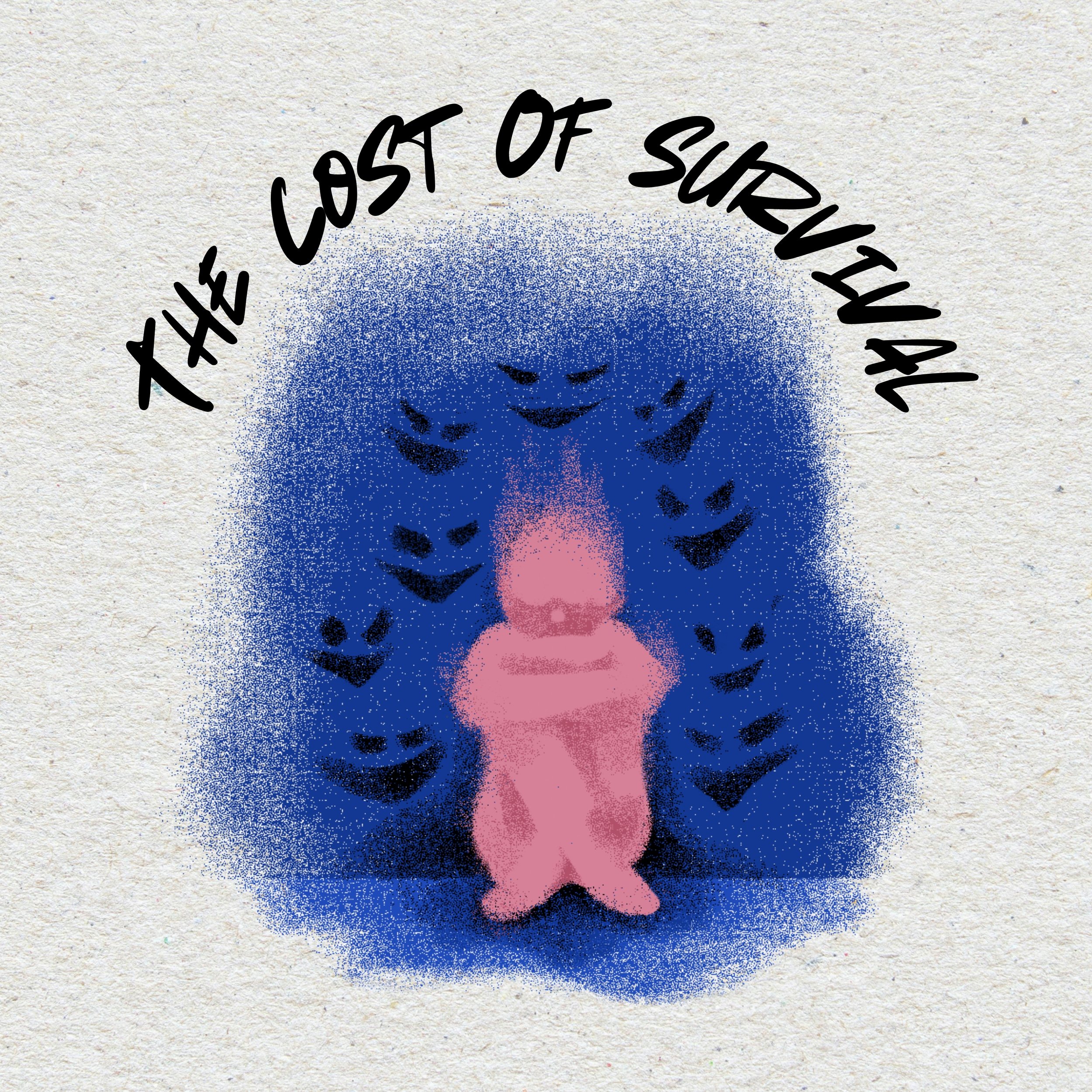
To heal from trauma, not only do you have to deal with what happened back then, but with the ramifications of what you did to survive. The cost of survival? You have to heal twice. Both from the initial woundings and from the cost of your survival.
As a counselor and psychotherapist I often see this playing out in the lives of my clients, and I see it in myself as well. The cost of survival is such an important thing to talk about because so many people feel like they escaped from something, but they still don’t have the life they want to have. In this post, we will talk about the cost of survival and the multi headed hydra of trauma healing, as well as the signs that you are healing from trauma.
The Cost Of Survival: You Have To Heal Twice
First, you realize that none of this is normal. That what you are going through is in fact significant, extreme, and every other negative modifier of the term you can imagine.
Then, you (slowly) develop the self-respect necessary to consider making a change, or else your suffering is so significant that you know that something, anything, would be preferable.
Then, you manage to fight through the sludge of self-agency, the notion that your actions can in fact impact and change your world, perhaps even changing things for the better. Eventually you reach out to friends, supportive family members, and maybe even take yourself to a therapist, hoping beyond hope that they can read your mind because expressing all of the confusion and mess is simply too much.
You finally leave. You finally escape. It’s over…
Now years have passed and you are still objectively ‘safe’ but it doesn’t feel that way. Small words, certain smells, a certain kind of physical contact all serve as confusing triggers. You are not as functional as you should be, you struggle to establish routines, hold down a job or relationships, and you simply don’t feel right. Chronic pain and other issues arise. You are surviving sure, but you are no way near thriving. It is like you are moving through life burdened by a weight only you can see, feel, and carry.
Back to therapy, only this time the attention is internal and towards the past. What is happening now isn’t the problem but rather how your past feels about it is. You can’t let go because you don’t realize just how close to the skin what you need to let go of is. You have been holding onto it for so long that it simply feels like another part of you.
But nonetheless, you know, even on the good days, something is not quite right, and on the bad, you are barely able to continue.
So you cycle through a bunch of different and alternative modalities. You take some medication (prescribed, self-medicated, or plant), do copious amounts of self-work. Read all of the books and continue to push through the negative self-talk that says you should just give up and die.
You try everything. Twice.
And then miraculously, one day, things start to shift. You suffer fewer panic attacks. You can make your bed. You establish a daily routine. You start working again, this time in a field that actually brings you a modicum of joy. And perhaps, just maybe, you start having some hope that you got through the thick of it all.
Then it hits you.
The second wave of healing. You did what you had to do to survive. You fought back. You fled. You changed your inner and outer state to avoid the identity crushing contradiction implied by that thing that happened to you. You filled the hole inside with whatever you could in order to make yourself whole. And it worked. But now you have to heal from your survival.
Because the truth is, no matter how far you run, you take it all with you. And there is always more to be done.
At the time of writing, I am a 38-year-old man. I am also a survivor of childhood sexual abuse and neglect. I moved out of home at 16, running away to keep myself safe. I lived off government supports, charity, and part-time work to finish university. I survived, but that survival came at a cost.
In order to be able to keep living with the continual bodily reminders of the abuse, I needed to adjust my own view of the world and myself within it. As the years passed, I adopted multiple different coping strategies to survive.
Survive I did, but now I need to survive from the downstream ramifications of those strategies as well, and really consider the cost of survival.
The Cost Of Survival
Initially I chose to dissociate.
I distinctly remember choosing not to feel. It sounds odd to even consider this now, but I fully believed that I could simply switch off my emotions. That I could force myself to forget. That I could make myself believe that none of this (the trauma) was real and that it was not happening to me.
To an extent, I was successful.
I became numb, but that numbness quickly spread to all aspects of my life. I wanted success, but I stopped caring if it came or not. I wanted connection, but didn’t care if people left. I wanted life, but stopped even believing that anything was real. By repressing the most significant trauma, I also repressed myself.
On the surface I was rigid and angry, but underneath I was anxious and scared. But over time I forgot why. I knew my past was ‘challenging’ but thought it was relatively normal. I would use cold logic to compare my circumstances to others (what I now recognize as a common trauma response) and found that others had it far worse than I, therefore I was fine…
I have been working to deconstruct this dissociative tendency ever since. Even now, as I write these words, a small part of me simply doesn’t believe this is real. That these words will be read, or that there is someone who will be read them. That thinks I am living in some imagined television show, just waiting for the channel to be changed.
That part is small, and I am now hyper aware of the feel of dissociation. There is a distinct flavor or vision whose presence I learnt to become aware of and address, primarily through therapy and meditation.
I have learnt that the body really does keep the score. I had significant pains in my back, belly, neck, and butt. All places that I can now directly tie back to the trauma, but initially searched for medical solutions to the IBS and chronic presentations.
When we face overwhelming circumstances that we cannot or don’t know how to process at the time we hold onto it. Tension, pain, reflexes, illness, and confusing psycho-somatic responses that can feel so central to your sense of self as to make you believe that they are in fact you.
As a victim of child sexual abuse, my body would keep reminding me.
I felt constant tension that manifested as arousal. Initially I believed myself to simply have a high sex drive (maybe I innately do, I don’t know) but the reality is that those feelings have been compounded by an internal defence mechanism that caused me to subconsciously justify the abuse and subsequent bodily feelings.
Lots of therapy has helped me deconstruct the inner why, and doing so has helped some of it to release. Abuse caused tension, tension that still remains, tension that is far more palatable and acceptable to my conscious mind when reframed as arousal.
It is okay to be aroused. It is not okay to be abused… or so that part of me would believe,
I am not a victim. I am simply embracing my sexuality, or so I would tell myself.
I did not choose this internal response to the trauma, rather it chose me. My body and mind survived in whatever way it could, and now I am picking up the pieces.
I have had issues with porn addiction and have had multiple relationships that were primarily based around little more than the release found from friction of the flesh. Others where I simply was not interested in the person but such was this innate pull towards sexual expression that I felt compelled to go there with them. Suffice to say the emotional cost and pain of such shallow relationships were not worth the cost.
What’s worse, is that those experiences did little to dampen the physical sensations arising. I have now recognized this as an addiction response. I would use (sexual release) to stop feeling (the physical tension) but those sensations would only abate for a moment before returning in vigour. Time and time again the cycle would repeat.
When I introspect upon these physical sensations I am often overwhelmed by the sheer intensity of those feelings. They come in layers, the first being the protective arousal and hypersexuality. But when those waves pass, they reveal a core of pain, nausea, and shame.
The cost of survival for me was first to dissociate and when that failed, was to reframe what happened to be a desirable outcome, changing the very nature of my personality and desire to fit with the events that happened.
I chose to flee physically, but long before that my body chose freeze, fawn and fantasy. Fighting was never an option. I was too small and dependant to risk such externalized aggression.
The Multiheaded Hydra and the Cost of Survival
You know the mythical hydra? The demon who, when you chop off a head, sprouts two more? That’s what healing feels like. As I deal with the dissociation and hypersexuality I discover more and subtler layers of brokenness, caused by the actions I took to survive.
I grew up poor and moving out of home early solidified a poverty mindset that only became apparent years later.
One day I was taking my girlfriend to a shopping centre and it was raining. I chose to park the car in an open air lot. She asked my why I didn’t go in the undercover area close to the entrance as there were clearly spots visible.
‘People like me don’t deserve to park there’.
It took a lot of inner work to deconstruct that one.
There are many more layers to the cost of my own survival, each one subtle and unique, requiring significant time, self-love and therapeutic support to unpick, but what I want to highlight with this post is that chances are you are also facing analogous needs to heal from the cost of survival.
What I know now is that when we choose to escape and heal, we may inadvertently damage ourselves in the process. In order to survive, we turn to fight, flight, freeze, fawn, or fantasy: defence mechanisms that kept us alive, that have now become part of our complex problem that seems to act like a multiheaded hydra.
Heal from one thing, something else pops up. Establish a routine that works, we self-sabotage. Connect to someone appealing, we dwell on their flaws.
If you can relate, I want to highlight that is normal and is a part of healing. Have hope that you can and are healing from the cost of survival. It will end. Eventually, and support is out there. Find a therapist you trust and share this with them. Both the initial traumas, but also the challenges of healing.
I believe in a three step approach to healing. If you were to summarize and synthesise all psychology theory, spiritual approaches, and self-help techniques, you would likely come up with these three steps:
Awareness. Acceptance. Action.
We must first become aware of what is happening within ourselves and in our environment. If we are not aware, we are acting blind. Then we must accept the nature of reality, as it is, for what it is, right now (we don’t have to like or approve of it, just accept it). Finally, we can take action to make value aligned changes. Then, as our actions change our state, the process begins again with awareness.
Suggested Actions To Help Alleviate the Cost Of Survival
1: Daily Mindfulness Meditation
This will teach you to become aware of where your mind is and to focus it. It will help you identify, detach from and heal negative self-talk and limiting beliefs. It will help calm the nervous system. Here you can download a free guided introduction to mindfulness.
2: Intuitive Guidance
This is an approach of somatic introspection and reconnection. With an attitude of compassionate curiosity and calm confidence, you turn your attention inwards to the body and simply listen and feel what arises. This is deep self-healing work. (Click here to download a free 5-session audio course.)
3: Exercise
Move your body. Exercise builds strength, mindbody connection, health, and confidence. I practice martial arts, yoga, and weight training, but all exercise is valid and necessary. Find something that you can do daily that gets you moving, preferably with others!
4: Therapy
Find a therapist that you trust. Someone that you feel safe enough to work through these deep, challenging, and personal concerns with. You need to be able to be open and honest with this person and it may be a long-term relationship, so shop around until you find the right fit.
Signs You Are Healing From Trauma
The cost of survival is real; we must heal twice. But what are some of the signs that you are healing from trauma?
I operate from a person-centred approach, a therapeutic modality whereby the person (client) is the expert of their world and can choose what success looks like to them. As a therapist, our role is to help the client become aware of their view of success, and then help them to clarify those views and how they can get closer to it.
So, in a way, you get to decide what healing from trauma, and from the cost of survival, looks like for you. That said, there are a number of general principles you could consider when looking for signs you are healing from trauma:
Increased functionality: You are better able to work, study, maintain routines, care for yourself, and engage with daily life.
Reduction of symptomology: You experience fewer or less intense symptoms such as anxiety, depression, dissociation, panic, or emotional overwhelm.
Expansion of social connection: You feel safer connecting with others and are better able to build and maintain healthy relationships.
Improvements in sleep: You fall asleep more easily, sleep more deeply, and wake feeling more rested.
Greater connection to your body: You become more aware of your physical sensations, emotions, and needs, feeling increasingly at home in your body.
Increased resilience (ability to sit with uncomfortable feelings): You are able to experience difficult emotions without becoming overwhelmed or needing to immediately escape them.
Reduction of hypervigilance and survival responses: Fight, flight, freeze, fawn, and fantasy responses occur less frequently and you recover more quickly when they do arise.
Increased self-compassion: You begin treating yourself with the same kindness, patience, and understanding that you would offer someone you love.
Final Thoughts on the Cost of Survival
Healing is rarely as simple as addressing what happened to us. We must also heal from what we became in order to survive it. The very strategies that once kept us alive can eventually become the things that keep us stuck. This is not a failure. It is not a sign that you are broken. It is simply the cost of survival.
If you recognize yourself in these words, know that there is hope. Every survival response developed for a reason, and every one of them can be understood, appreciated for how it protected you, and gently processed and reintegrated.
I practice Intuitive Guidance daily, a process of somatic reconnection with parts that are holding onto trauma and burdens from the past. In this process we hold that the body keeps the score (getting stuck in fight, flight, freeze, fawn, or fantasy), and that thoughts, emotions and sensations are messages.
To practice, we embrace and embody the Self (intuition) and then invite into the session a part of our body that is holding onto the past, and then feel deeply. Over time, this connection allows expression, release, reconnection, and eventually reintegration.
Through an attitude of approaching and accepting whatever arises with compassionate curiosity and calm confidence, we can heal.
I offer a free 5-day Intuitive Guidance course here, and we can also explore the practice in a 1:1 session.