Stigma, Medication and Mental Health
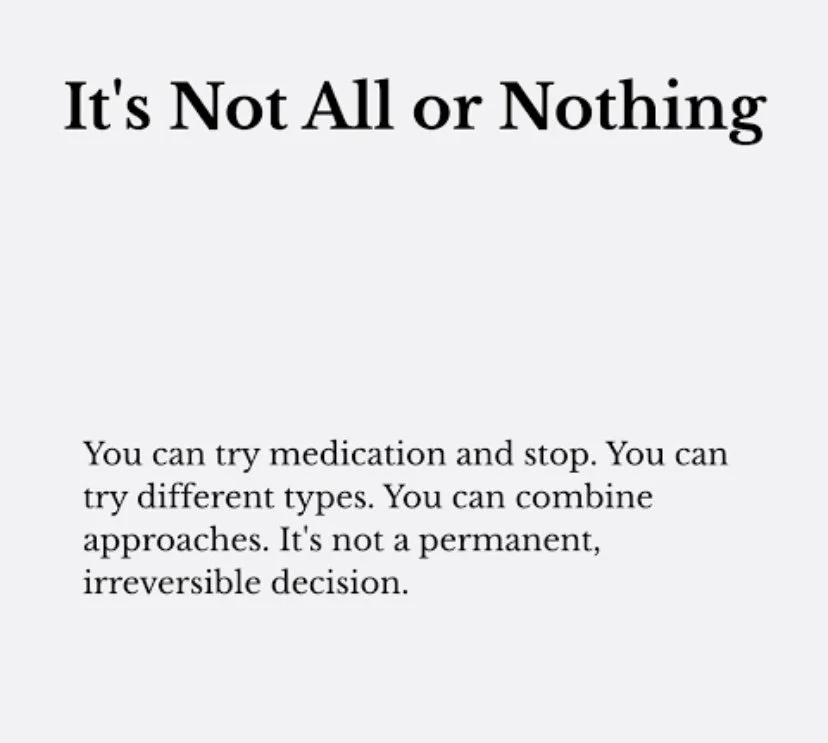
My first exposure to medication and mental health came from a 15-minute consultation with a psychiatrist. I shared my feelings of persistent low moods and chronic anxiety and was immediately put on Escitalopram, 10mg a day for the rest of my life. I was told to get repeat scripts from my doctor and sent on my way.
No talk therapy, no long-term planning for the medication and mental health, no contingencies, no connection, and no bio psycho social spiritual model. Nothing.
Very quickly I realized two things. The first is that the side effects of SSRI-medications can be horrific and second even if they worked to reduce the symptoms, the underlying cause of the problem would not be addressed, not without other interventions.
Skip forward a few years and my anxiety and depression were getting worse.
Over the years I had tried multiple different medications, with the best results being a muting of life. The lows were no longer as low, but the highs were gone as well. It was as if all meaning and color had been taken from the world. I didn’t want to end things, but I didn’t want to do things either. The connection between medication and mental health was very complex for me.
I FLOAT
The vastness of the ocean
Has been replaced
By the safety of kiddy pool
I float
Under a lifeguard’s watchful gaze
Passively accepting
The artificiality of my confines
Only vaguely aware
Of a time
Not long ago
When I could look upon the horizon
And feel the sun upon my skin
Memories
Of riding atop the waves
Both terrified and exhilarated
By nature’s limitless beauty
Have been replaced
By the scent of chlorine
Penetrating my nose
And irritating my eyes
But I don’t care
I am lulled by the warmth of the water
And comforted by the knowledge
That soon
I will forget
The taste of salt water
And the thrill of that first plunge
Into the depth
Of the ocean’s
Infinite embrace
The logic of the medication model was simple but fundamentally flawed. The idea is that if you intervene on the biological level with medication, the patient would figure the rest of it out. With better internal chemicals they will be able to better address whatever it is that was bothering them (or that problem would simply go away as all it ever was, was an imbalance).
These assumptions are faulty and dangerous to say the least. Even if the problem began as entirely biological, the patient learns to respond to those imbalances with increasingly problematic coping strategies. Avoidance, drug use, risky behaviours, distorted thinking patterns and a host of other defence mechanisms are learnt merely to survive.
These do not disappear the moment your internal brain chemistry is balanced, assuming of course that you even get the medication choice correct. Medication and mental health do go together, and medication helps people with their mental health, however the road can have a lot of twists and turns before you find the right medication for you, and you have to do the other things too, the talk therapy and the self care and the lifestyle changes.
SERTRALINE
Medication?
More like calcification.
The myopic solution;
Replacing anxiety
With apathy.
Losing focus,
Focusing
On what I have lost.
My thoughts,
Circle the drain.
Both hope and fear
Falling in turn.
I am lost.
A rudderless raft,
Left to drift
Upon a dead calm lake.
Fog obscures the bank.
Fog obscures desire.
I am far too calm
To stay safe.
Life and death
Seem equally desirable.
I drift.
Cold rationality;
The last remaining
Life preserver.
The small subtle voice
Whispering
That this too shall pass;
The sun will shine,
The wind will blow,
And I will have purpose once more.
There is a tremendous amount of stigma around medication and mental health.
You first have to accept that you are broken. That for whatever reason who you are, at your core, is not able to cope with life as it is.
You look around and see everyone else simply doing life and wonder what is wrong. Why can they function when you can’t? So, you tentatively reach out, perhaps to a friend or a family member who, unless they themselves are medicated or supportive, may be quick to offer clichéd and frankly useless advice.
They cite news reports and talking points about the over medication epidemic and the long-term impacts. They suggest the implied weakness and the need to harden up. They mimic either tacitly or overtly the stigma and shame we all have been exposed to over the years. This, while they hypocritically drink daily, smoke, binge watch television, consume endless carbs or do any other of the other socially acceptable vices society has to offer.
The Bio Psycho Social Spiritual Model Of Mental Health
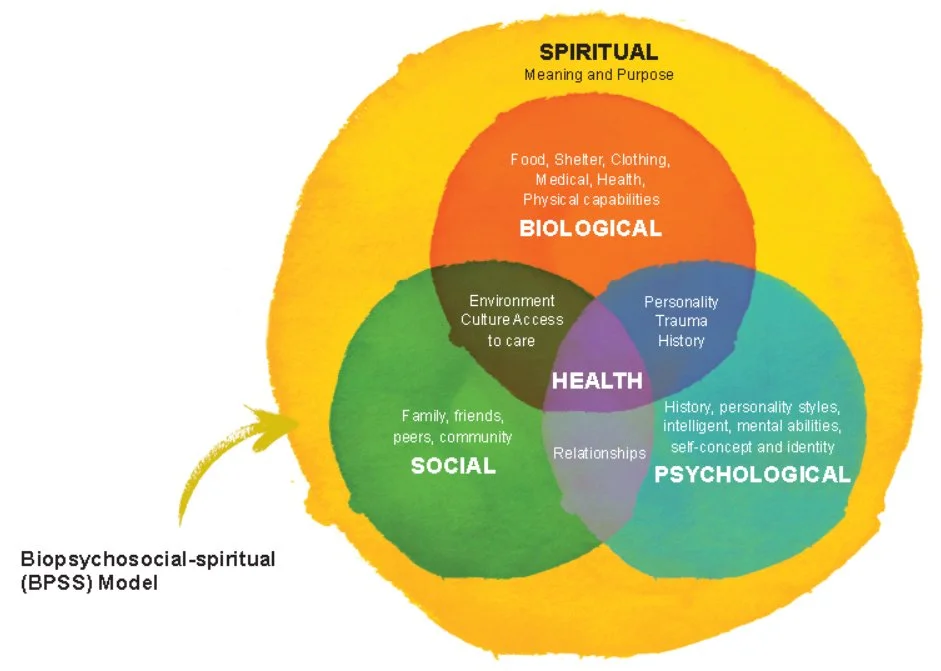
The bio psycho social spiritual model of mental health is a holistic way of understanding human wellbeing. Instead of seeing mental health as purely biological or purely psychological, this model recognizes that our wellbeing is shaped by multiple interconnected areas of life: our body, our mind, our relationships and environment, and our sense of meaning or spirituality. The bio psycho social spiritual model is often used in counseling, psychology, social work, and pastoral care because it looks at the whole person rather than just symptoms. It is important to look at the whole picture when talking about medication and mental health, as our mental health is so interconnected with not just our brain chemistry, but also our situation in life, history, perception of meaning, our relationships and how we feel about community.
Almost immediately upon swallowing that first pill all those years ago, I had the sinking feeling that it wouldn’t actually help. I was young, but I intuitively knew that just taking medication wouldn’t be enough, but felt utterly unsure about who to speak to or what to say.
CAN’T QUITE EXPRESS
There are things that I want to say, but just can't quite express
Ruminations and meditations that I'm too afraid to address,
Like the veil over my eyes that keeps me hidden from the stress
To the dark wishes that I'm fighting to suppress.
Like the fear and anxiety that I will constantly transgress
To the past expressions that I am never going to confess,
Like how everything I do causes me nothing but duress
To the unwavering ache and torment that’s causing me to regress.
I must profess, I desire to express my stress, confess to address this abscess.
To obsess on happiness, to aim for excess and to stop living like a such a mess.
Yes, I want to make progress but there are just some things that I can't quite express.
So, I studied, first psychology, then spirituality and mindfulness, and eventually counseling. What I discovered was something that is so intuitively obvious that it shouldn’t need to be highlighted, but considering my (and many peoples) experiences addressing their mental health in traditional (western) means must be explained.
We are not only biology.
“Health” is determined by multiple factors intersecting and impacting one another. Or biology is just one part of a larger model. We must also take into effect our psychology, social influences, and spirituality. When talking about medication, and mental health, we have to talk about all the other factors too.
Indeed, if you are struggling and want to heal, you should be intervening in every area. No one impact alone will be enough. We all need to look at bio psycho social spiritual influences.
So, when I, at a young age, took myself to the psychiatrist, I certainly should have been given medications (they saved my life), but I should have also been guided towards talk therapies. My social situation should have been considered and I should have been supported in leaving a toxic and abusive home environment. I needed to be supported to learn the skills necessary to survive and care for myself. It would have been significantly beneficial to be given the tool of mindfulness meditation and other forms of spiritual practice to find focus and meaning beyond the daily grind.
But I wasn’t.
Instead, I was left to suffer for countless years on a meandering journey of painful self-discovery, of trying countless interventions, medications, therapies and other approaches. Trying to figure it all out for myself. All the while pushing through the stigma and shame of medication and mental health. Every time I shared my journey or asked for advice, I risked derision and judgement.
I faced a dark night of the soul, but thankfully I pushed through.
I learnt to eat well and exercise daily (biology).
I began meditating and writing (psychology and spirituality).
I practiced martial arts and chess (social, biological, psychological).
I moved into a safer living environment (social).
I began studying and working (psychological, social).
Simply put, I began making changes across the board of bio psycho social spiritual interventions that slowly impacted every area of the bio psycho social spiritual aspects of my life.
Medication is only one of a myriad of interventions that I (and perhaps you) need.
Capitalism, Medication and Mental Health
My psychologist is great.
The first thing I said to her in our first session together was that I don’t trust her. I previously had some extremely unprofessional and unethical experiences with therapists and was cautious to say the least about starting again.
I didn’t want to be abused, used, or left vulnerable and alone. Again.
I told her as much and more. Highlighting that it was in her financial best interests to keep me well enough to not leave, but sick enough to stay and rebook. She smiled and highlighted that she can see that we would need to establish trust and that perhaps we should give it a few session and assess from there. Three years later and she has helped me significantly. Yes I am still a paying customer, but under her care, I am trending upwards.
I faced a similar concern with medication, and the relationship between medication and mental health.
It is profitable for me to be prescribed medication that I am now to be taking for the rest of my life.

Of course, if I need the medication, it is necessary. But it still doesn’t feel quite right. The thing that finally tipped me over the edge of once again accepting medication was how close I came to ending things, combined with an acceptance of the abnormality of the world. I credit Gabor Mate’s book The Myth Of Normal and Sebatian Jungers book Tribe with finally opening my eyes to the reality of the world and why there is something that feels not quite…right.
Simply put, none of this is ‘normal’. We didn’t evolve to live in mega-societies, to have 24/7 news, to have money, or street lights, or podcasts, or even fences. Simply put, modern life is akin to a fancy zoo enclosure, and that unsettling ‘not quite right’ feeling is the result.
My brain chemistry is off because of the fucked-up nature of the world.
Perhaps if I lived in a different time or place, or had a different upbringing I wouldn’t need it. But this is the world and this world raised me, so perhaps it can also help save me.
Try Everything First
Over the years I have tried multiple types of SSRI’s for depression and anxiety, almost all of which produced negative side effects. I ended up figuring out that I must try everything to figure out what is going to work for me. So, I extended my search.
I tried psychedelics, Vipassana Retreats, St John’s wart, B Vitamins, and other alternative therapies and interventions.
I tried Transcranial Magnetic Stimulation (TMS), a procedure whereby the emotion regulation parts of the brain are stimulated and encouraged to fire more often, thereby producing calm.
I tried medicinal cannabis in all its various varieties. Smoking, vaping, oils, and eating. It helped in the moment, but the next day I was always worse, a downward spiral I was quick to exit.
I tried EMDR (Eye Movement Desensitisation Reprograming) a deeply confronting process of directly facing and reliving the most traumatic parts of your past whilst watching someone move there hand back and forth (sounds silly but it is scientifically verified and extremely beneficial).
I also got a genetic test to see why all the medications were not working, with almost all coming back as being either ineffectual or potentially adverse affective. I even applied for a psilocybin study that would involve massive doses of magic-mushrooms under the supervision of therapists and nurses.
All of these approaches ‘worked’ in the sense that they kept me alive and offered incremental improvements and hope for more. But more was and is always necessary.
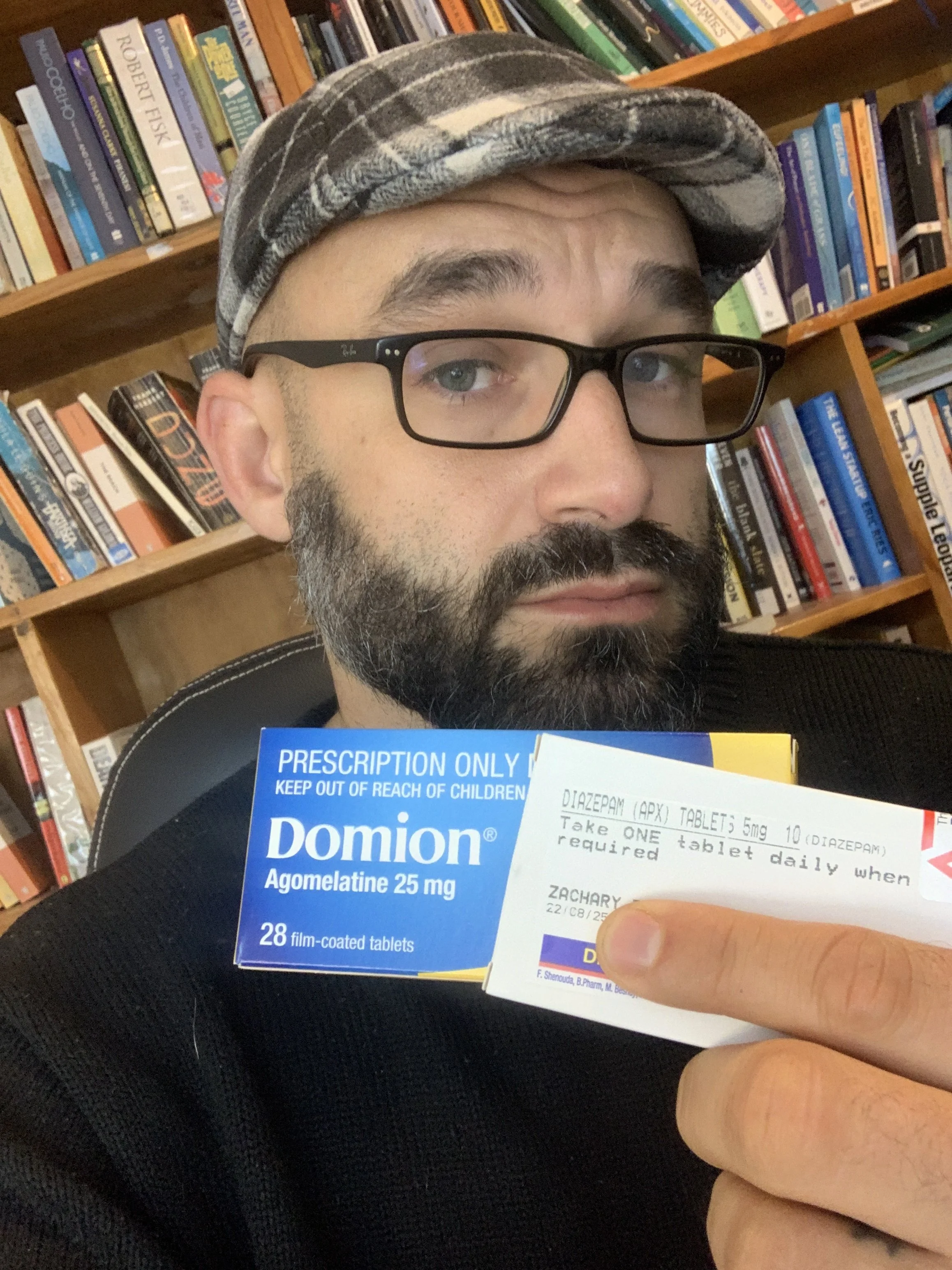
Then, thankfully, my doctor suggested ‘Agomelatine’ a melatonin based anti-anxiety medication that has the added benefit of sleep assistance, along with Valium to be used as a PRN (when needed).
Combined this approach to medication and mental health has finally began to turn the tide. I am finally FINALLY starting to see the light and get my life back in order. But, and I cannot stress this enough, medications alone would not be enough on their own.
They are part of a multifaceted approach to mental health management approach that involves tremendous amounts of daily (non-biological) self-care. I developed and practiced Intuitive Guidance, and introspective process of self-healing whereby you connect to the traumas held in the body, allowing it to express and release and reintegrate.
And the stigma and shame? Fuck it. And fuck anyone who says otherwise. I am sorry for the language, but it is obscene to suggest otherwise. If you are doing all of the right things and you also need medication, take the medication. If someone broke their leg, they need pain killers. Diabetics need insulin. If you step on a rusty nail, you may need a tetanus shot. If you get a virus, you may need antibiotics. Just because the illness is invisible, doesn’t mean that you don’t need medication.
A Word Of Caution On Medication And Mental Health
There is a trap that happens to some people when they take medication for their mental health. It begins to work. Things start to improve, and they believe they no longer need to take the medication.
This has happened to me, more than once.
Inherently I would love to be medication free, so, when it begins to work, there is a small part of me that believes I don’t need it. So, I stop taking the medication and inevitably my mind (and then life) falls apart.
Then, eventually, I get back on the medication and the cycle repeats.
I am not saying that I (or you) will be on it forever. Eventually you may find that your ability to impact the other aspects of your life will be enough to mitigate the need for medication, or perhaps your biology will change.
Hopefully.
But before you make changes, have a long conversation with your doctor, psychologist, (trusted) friends and other experts in your life. That way you won’t be removing one of the key components of your mental health.
TAKE THE DAMN PILL
Take the damn pill,
You’re on it for a reason.
It’s to stop you feeling ill,
To keep you from self-treason.
Sure you’re feeling fine,
But how long will it last?
You know you’re not divine,
Just look back at your past.
There was that time you went cold turkey,
When you knew it would be fine.
Instead your mind went murky,
And you turned to a life of crime.
Or when you got the jitters,
So bad you couldn’t sleep.
Feeling your skin crawling with critters,
Causing you to weep.
Or that time you almost died,
When depression come back strong.
Or the time that you lied,
To yourself that something wasn’t wrong.
Take the damn pill,
You’re on it for a reason.
I don’t want to be reading your will,
As the last act of the season.
Finally, and because I couldn’t fit it anywhere. Don’t listen to the well-wishing (but perhaps ignorant) people who tell you to stop taking the medication in favor of a supplement, herb, crystal, prayer, or other practice.
They do not know what they are talking about. They are not experts. And if they are, you are not their clients, thus it is not their role to tell you what to do.
Those interventions may work. They may, but if they cause you to stop taking your medication, the consequences may be catastrophic.
Consider the advice given, but also consider if you even asked for it. If someone offers you unsolicited advice, chances are they are trying to convince themselves and you will end up the victim.
Trust the process. Take your medication if you need to, and always continue to do the self-care and other things that have been proven to work for you.