A regular mindfulness practice can have a profound impact on your mental health, but the benefits do not have to end when your meditation session is over. As a psychotherapist, author, and meditation teacher, I encourage a holistic approach to mindfulness that includes trying out lots of different types of meditation.
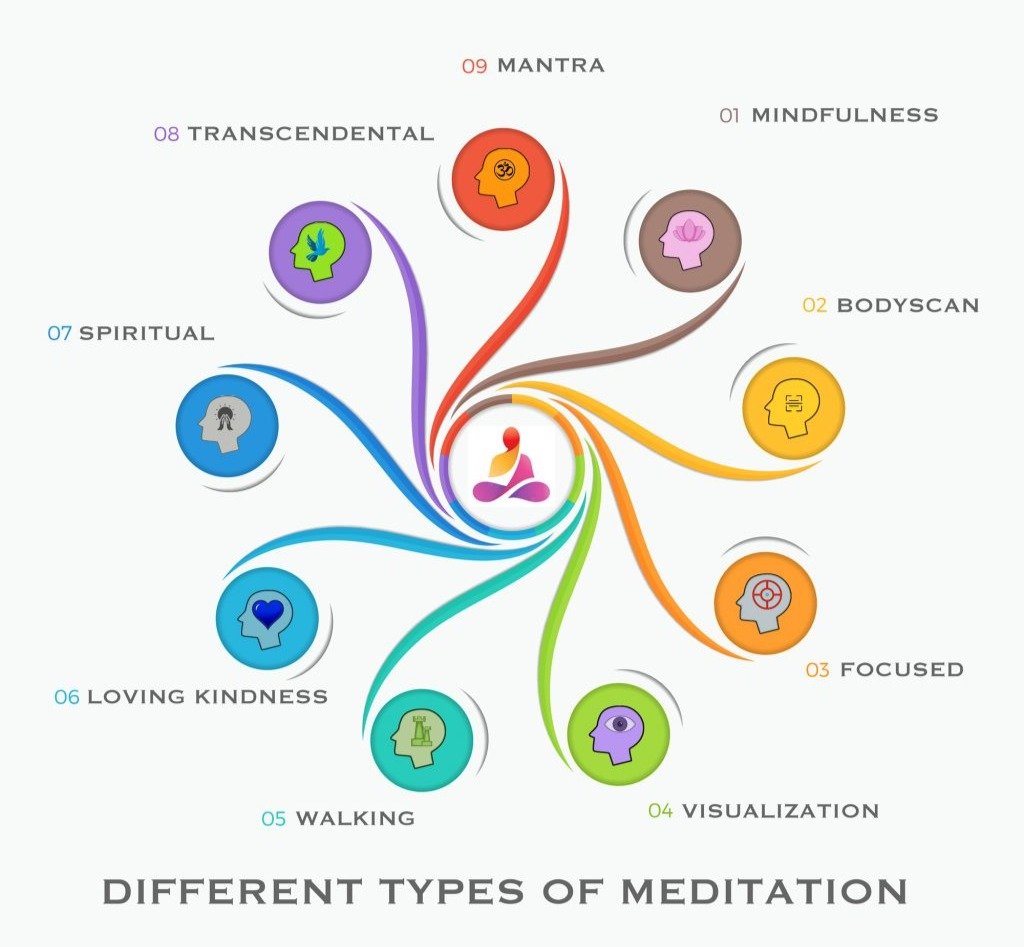
In this post, we will talk about a range of practices that can both enhance and complement your mindfulness practice, and also work as wonderful standalone meditation techniques themselves. So have a read and a try of these different types of meditation, alongside your mindfulness practice, and see how you go. You may find each ones gives you something different.
- A chapter from the book Mindfulness, A Guidebook to the Present Moment -
On its own, mindfulness will be a tremendous boon to your mental state, relationships, and overall functionality; but there are some complimentary practices that when combined with mindfulness, can produce additional benefits in the practitioner’s life.
Not everything that follows will be for you and that is okay. Consider these as optional extras, or side dishes to the main that is mindfulness. They are certainly not necessary, but some people swear by them. They also are wonderful practices to do on their own as well, if you want to. It is important to try different types of meditation and see which ones work best for you.
Check out this mini mindfulness course I made.
Breathwork
Breathwork is the practice of controlling and slowing one’s breath to produce relaxation and reduce anxiety. There are entire traditions built around the practice of slowing and controlling the breath, and there is scientific evidence supporting the calming effects of breathwork on the body.
The mind and body are totally interconnected. What happens in one, directly impacts the other. If the body is tense, with fast and shallow breathing, the mind interprets these signals as potential danger; leading to stress and anxiety. Alternatively, when the body is loose, and the breath is slow and deep, the mind interprets these signals as a sign of safety; leading to relaxation and calm.
Thus, we can use physical relaxation techniques like breathwork to positively influence the state of our mind. Breathwork is one of my personal favourites in the different types of meditation.
Glimpse: 10 Deep Breaths
Take a quick mental stock of how you are feeling. How stressed are you? Is your mind or body tense? What is your mental state like in this moment? Now take 10 deep breaths. Slowly in through your nose, and gently out through your mouth. Take each breath as slowly as possible, while remaining comfortable (you do not want to be straining).
How do you feel?
How to Breathe
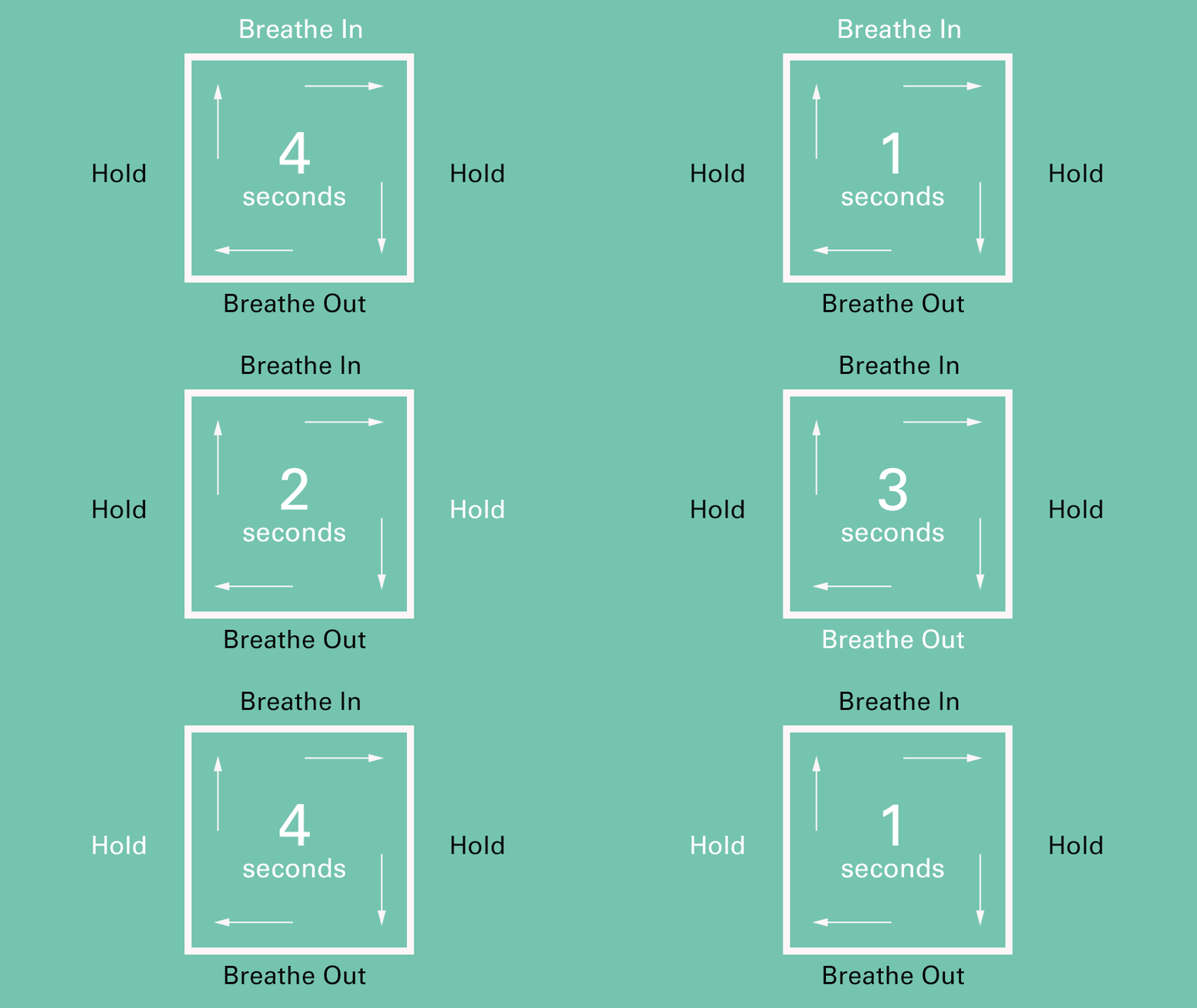
As part of learning about different types of meditation, we need to learn how to breathe. Below you will find a collection of different slow breathing techniques and tips on how to breathe. Each emphasize different ‘counts’ for the different stages of the breath: in, hold, out. Each approach has its advocates, but I suggest that you try them all and use the breathing pattern that produces the best reaction for you.
Make sure that you are breathing in through the nose and out through the mouth. You will need to practice how to breathe. Do this gently, there should be no strain, pain, or excess effort. You want to breathe into your stomach. This means that on the in breath, your stomach will rise and fill first, and then your chest. On the out breath, the air leaves your chest first, and then it leaves your stomach. This may feel a bit forced at first, but with some initial effort, it will soon become unconscious. Stomach breathing is the more natural way to breathe. Watch an infant and you will notice they do it automatically.
At first, controlling the breath may feel odd and could be quite challenging, but it is a really important part of trying different types of meditation. So, try each of the following patterns of breathing continuously for five minutes, or if you use meditation or mala beads, one full set. That way you will be able to push through any initial issues and really feel the benefits of the practice. I also encourage you to tweak the time where needed, add or subtract a second to the stages of breath where necessary in order to be comfortable, but keep the same ratios.
Box Breathing
Breathe in for 4 seconds.
Hold for 4 seconds.
Breathe out for 4 seconds.
Hold for 4 seconds.
Repeat.
Click here for a guided box breathing meditation
4 7 8 Breathing Technique
Breathe in for 4 seconds.
Hold for 7 seconds.
Breathe out for 8 seconds.
Repeat.
Click here for a guided 4 7 8 Breathing Technique Meditation
Equal Breathing
Breathe in for 4 seconds.
Breathe out for 4 seconds.
Repeat.
I use these breathing techniques as a counter to anxiety, as a sleep aid, and a lead into a mindfulness meditation practice. While not necessary, starting mindfulness meditation with a relaxed body and calm mind can make the entire process more enjoyable. If we are going to be observing the present moment, why not make that moment a touch better? I also use these calm breathing techniques in conjunction with yoga and stretching for added relaxation. Combining different types of meditation is something I find very helpful and relaxing.
Breathwork can also be used to stimulate and reinvigorate the mind. This is particularly useful when we are feeling tired or out of focus, both throughout the day, and during a meditation session. Rather than risk falling asleep, I will instead briefly do some of the some of the following breathwork and then get back into the mindfulness practice. Just a brief warning, these techniques can lead to feelings of lightheadedness and faintness if overdone, so practice with care, and start with just one breath. With practice and self-awareness, you will be able to increase the amount.
Stimulating Breath Technique
Breathe in through the nose as quickly as possible (full breath, into the stomach)
Breath out through the mouth as quickly as possible.
Slow In, Fast Out Breath
Breathe in slowly for 4+ seconds
Breathe out quickly, through the mouth, powerfully. Make a ‘hah’ sound.
When combining breathwork with our meditation practice, there is a risk that we will start to control the breath throughout a mindfulness session. If the breath is our focus or meditation anchor, things can get a bit muddled. You may find yourself focused on the breath as well as attempting to control it, or you may feel like the breath has moved into the realm of conscious control. If this happens, you can simply change the focus of your practice to another object, for example sensations of the hands, or sounds, until you are breathing naturally again. You won’t have all the different types of meditation perfect all at once, and they will all never be perfect! Just have a go and see what happens.
Metta Loving Kindness Meditation
Metta loving kindness meditation is a complementary practice that is commonly given by masters, traditions, and texts alongside mindfulness. It is a wonderful addition to the different types of meditation. The basic idea is that you consciously foster feelings of compassion, kindness, love and other positive feelings towards yourself, the people in your life, and the world at large. There are some interesting metaphysical and karmic explanations given for why you should add Metta loving kindness meditation to your mindfulness practice. However, there are benefits to be found with Metta loving kindness meditation even if you approach it from a purely secular or agnostic perspective.
The basic idea is that the more positive feelings you have for those around you, the more ethically you will behave, and the better you behave, the less negativity, guilt and other bad emotions will arise in your mindfulness practice. Thus, your meditation sessions will be purer, and insights will come easier. If instead you act unethically, your mindfulness practice will reveal that fact to you, and you will be forced to wade through the emotionality and impact of your actions. A mind that sees itself, others, and the world at large through the lens of love, compassion, care and kindness is of course much nicer to inhabit than one that is negative and pessimistic.
Metta loving kindness meditation can be performed as its own practice, or as a lead into or out of a mindfulness practice or into or out of any of the different types of meditation. To perform Metta loving kindness meditation, you hold the image (visual, feeling, essence, or symbol) of someone in your mind, and project positivity towards them.
May you be free of ill will.
May you be free of suffering.
May you be full of loving kindness.
May you be happy.
Those are the words I use, but any words with a similar sentiment are appropriate. You could also choose to visualize a color or radiant energy flowing towards and embracing them, or warmth or any other symbolic representation of loving kindness.
You can choose to practice Metta loving kindness meditation on yourself, on those close to you, on someone who you have a complicated relationship with, and even eventually people who have wronged or harmed you. Start slowly, and make sure that before you move onto challenging people you have a solid basis in the practice, and if at any time you find the feeling of Metta loving kindness meditation dwindling, return your focus back to an easier target to get back into the practice. If you are struggling, try imagining them as an innocent baby and send your Metta there.
At first, Metta may feel forced or fake. Almost like you are going through the motions, with little true feeling behind it. Sometimes this can happen with other different types of meditation too, but I find it most common with this one. I encourage you to persist with the practice, because that act of persistence, and your intentions behind doing so, is itself an act of loving kindness. You truly do want the people in your life, and people in general, to be happy, and free of ill will, even if you do not ‘feel it’ yet. Eventually however, you will find that you can slip into Metta easily and foster feelings of loving kindness towards any target.
Metta Loving Kindness Meditation
Start a timer for 10 minutes. Close your eyes and settle yourself into your meditation posture. Take a few slow relaxation breaths and bring to mind someone who you have an uncomplicated relationship with. Someone who it is easy to foster the feelings of loving kindness towards. Realize that you genuinely want them to have a good life. That you want them to avoid the major pitfalls and heartache, and that you want them to be successful and happy. Feel that feeling and project it towards them. Repeat in your mind the following words,
May you be free of ill will.
May you be free of suffering.
May you be full of loving kindness.
May you be happy.
For the rest of the session, you can of the session you continue to send Metta towards that person, or you could choose to shift your focus onto yourself, another person, your family, friends, strangers, the world at large or all living beings.
Click here for a guided metta loving kindness meditation
Visualization Meditation
A common accompaniment to mindfulness meditation is visualization meditation. It is commonly used for self-healing, goal attainment, and mindset change. When it comes to trying different types of meditation, I really love visualization especially when I want to make some sort of change in my life.
The basic method of visualization meditation involves the practitioner entering a state of relaxation through slow breathing. Then they will visualize a certain location, scenario, interaction, or spiritual energy that represents the goal of the practice. This often involves picturing the desired future state clearly in the mind and holding their attention on that imagery. This is where the trained focus from mindfulness can benefit the visualization practice, as it will enable a longer and clearer hold on the visualization.
Of course, this practice of visualization meditation is seemingly at odds with acceptance of the present moment as it is for what it is. Desiring to change something implies a negative judgment about it, and thus runs counter to mindfulness. Purists would advocate total acceptance and continued meditation as the only response to feelings of desire, inadequacies, and other forms of craving. And while I do advocate that mindfulness should be first and foremost, I am not against sculpting out a pleasant life, nor the pursuit of dreams. Rather I would just suggest that the life we are striving for should be in line with our core values as well as being as moral and ethical as possible.
I would not suggest that you visualize the ownership of a brand-new car, home, phone, car, or other worldly possessions, for their own sake. Attainment of such things will unlikely lead to lasting happiness, rather the material pursuits will simply change to a new thing. Instead, I suggest that you visualize on the happiness, health, success, and wellbeing of yourself and those around you, as well as for the attainment of a life that matches your values. For me, this is one where I can spend quality time with my family and friends and leave a positive mark on the world. A life where work feels like play, and life is more positive than negative. As far as different types of meditation go, I feel that visualization gives me a sense of hope and ownership of my life.
Let’s give it a try.
Glimpse: Visualization Meditation
Close your eyes and take some slow and calming breaths. Draw to mind something that you want; it could be to heal, grow, or change something, to get something or let go of something else. Picture it totally and fully. Immerse yourself in it. Bring in all of your senses; see, feel, touch, taste and smell this new reality. For the next minute hold this image in your mind with as much focus and clarity that you can bring to bear.
Mantra Repetition
Mantra repetition was my first introduction into meditation practice, before I knew anything about different types of meditation. A friend of mine gave me a set of Buddhist mala beads and a traditional mantra, and simply told me to hold the bead in my hand and repeat the mantra in my head. I was to focus intently on the feeling of the beads as I moved through the entire set, as well as on my repetition of the words in my mind. If my mind wandered, I was to return my focus back to the mantra repetition and the beads.
Although I did not realize it, this practice was simply another way to practice mindfulness meditation and was perfect for me because it gave my fidgety hands and mind something to do. I quickly noticed some of the many benefits of a consistent practice entering my life and decided to investigate meditation further. My research took me down many paths, one of which was mindfulness (the result being this book amongst other things), but also into the practice of mantra repetition across religions and other spiritual practices. It is interesting that when you look, you start finding different types of meditation everywhere, sometimes under different names.
I found that almost all religions and traditions use mantra repetition and prayer beads, albeit with slightly different back-end reasoning. Some will say it brings the practitioner closer to God and others imply that it purifies the mind. Some hold it at the forefront of their daily devotion, while others have it as an optional extra for the devout. Regardless, at their core, they all encourage the practitioner to focus on the words, the beads, and at times accompanying imagery. And if the mind wanders, they are encouraged to gently bring it back to the mantra.
To me, this all sounds like mindfulness, and as such seems to explain some of the benefits received by practitioners from different, disparate, and often contradictory religions. Many doctrines explicitly suggest that their religion is the only true religion, yet their practitioners often report similar feelings of clarity, healing, growth, and other benefits from their devotion. Could it be that perhaps they are all unknowingly practicing mindfulness? I am agnostic on the matter of religion. I am not making any claims about miracles, divinity, or other such esoteric phenomena, rather I am simply seeing trends in the practices across different religions and traditions, and the similar results of those practices, and then looking for commonalities. In this case, it is mantra repetition as another form of mindfulness practice. You can see how this idea can be applied to lots of different types of meditation too.
I use mantra repetition with beads as an alternative to traditional breath focused meditation, particularly when I am feeling agitated and restless. I carry a small set of beads in my pocket and take them out when I have a spare minute. They are a great tool to prime mindfulness; as I start moving through the set of beads, my mind quickly settles into the practice. The type and kind of beads you use do not matter. Any religious rosary or mala set will suffice just as well as wool, plastic, wood, or metal beads, or even a string of pearls.
Choosing a Mantra
When it comes to choosing a mantra, if you have a spiritual or religious heritage, you may wish to use words that correspond with that tradition to connect to it, or as a form of respect and devotion. Alternatively, you may wish to use a religiously neutral term, or something of your own creation. I am of the belief that provided you repeat the words mindfully you will get the benefits, but this view is not a common one. Teachers, gurus, and priests who give out a mantra like practices to their students will often insist that their specific words certainly do matter. Whether or not you agree is up to you. Regardless, when it comes to choosing a mantra, choose a phrase and try and stick to it, both for the duration of the session, and over the long term.
Here are some common mantras to help you with choosing a mantra:
Om Mani Padme Hum
Om Namah Shivaya
Om
Lord Jesus Christ son of God have mercy on me a sinner
Jesus
Subhan Allah
Alhamdu lilah
Allahu Akbar
Tat Tvam Asi
Mu
Love
Abundance
I suggest that you try them all and see which one works for you (just like you have been doing with all the different types of meditation). You do not want to be constantly second guessing your choice based on religious doubts, thoughts of sin, or any other such ruminations. It is about the mindful repetition of the words and the feeling of the bead in your hand.
Alternatively, you can practice mantra repetition with just your hands. Touch your thumb to the top of each finger and repeat the mantra. This will give you a four count before repeating. Or you can touch your thumb to the top, middle, and bottom sections of each finger in turn while repeating the mantra. This will give you a twelve count before repeating.
Glimpse: Mantra Repetition With Beads
Chose a mantra from above, and hold a set of beads in your hand, gently grasping the first bead between your thumb and forefinger. Repeat the mantra to yourself, and slowly move onto the next bead. Repeat this process until you have completed one set of beads and you are back to the start.
If you like, you can connect the breath to the practice, by taking a slow and deep breath with each new bead.
Glimpse: Mantra Repetition With Hands
Chose a mantra from above and touch your thumb to the top of your pointer finger. Repeat the mantra to yourself, and slowly move your thumb to your middle finger. Repeat this process with each finger five times.
If you like, you can connect the breath to the practice, by taking a slow and deep breath with each new finger.
Full Body Scan
When the mind is stressed, certain parts of the body can become inflamed, tense, sore or cold, and the full body scan meditation is very helpful. It is almost as if our bodies are attempting to alleviate the issues of the mind, or else are the holders of it. Regardless, I have found it beneficial to notice where my body is holding tension and then taking action to stretch, move, warm, or massage that part. Doing so often results in a reduction of anxiety and an increase in relaxation. Sometimes, these parts of the body make themselves immediately noticeable: the tension headache, butterflies in the stomach, or the tight lower back. But other times they are more subtle, often going unnoticed for months or years, only to reveal themselves as an injury down the line.
I use the practice of the full body scan to both notice, accept, and then actively release any body tension that arises, typically as a way to calm down before bedtime. It is one part mindfulness, one part relaxation breathing, and one part visualization practice. This is another one of those where you are combining a few different types of meditation.
I start with some calm breathing, followed by a general mindfulness meditation on the breath. From there I progressively move my attention towards my body and invite it to show me any tension, coldness, or other issues. When something arises, I turn my mindful focus onto that area and investigate it. When the sensation releases or dissipates, I return my focus back to the breath, and invite my body to show me something else. I repeat this process until I am totally relaxed, or my time is up. I will often combine the mindful focus on the area with the gentle tensing and releasing of the muscles in the area, a light massage, and a visualization of that area being healed with golden light.
Another approach to the full body scan is to slowly progress over the body, from the toes on the feet all the way to the crown on the head, mindfully observing each part in turn and addressing any tension in the same way as above.
Glimpse: Full Body Scan
Lie down, close your eyes, and take five slow and calming breaths. Now turn your mindful attention towards the sensations of the breath at your nose. When you feel your focus is strong enough, gently ask your body to show you any tension, pain, coldness, or other issues. When something arises, move your attention towards it, and investigate the feelings that come.
What do they feel like? Where are they located? How strong are they? Are there emotions, memories or visuals that come with the feeling?
You can choose to gently squeeze and release those muscles, massage that area, or visualize healing energy being directed there.
When the feelings dissipate, you can choose to end the session, or continue as above onto other areas of the body.
Lucid Dreaming
One of the major appeals of any of the different types of meditation is its ability to provide insights into the self. It is unsurprising then to discover that there is a major subset of meditators who also enjoy exploring their dreams. Lucid dreaming is the practice of becoming aware that one is dreaming, and then taking control over the events, context, and people within the dream. Once you know you are dreaming, you can choose to explore the dream world, ask your subconsciousness a question, relive a memory, fulfill a fantasy, or role play a future event. You can also practice mindfulness, observing your (dream) reality without judgement or filter, thereby observing your mind as it is for what it is.
If this sounds appealing, you are in luck. Mindfulness meditation seems to result in more vivid, stable, memorable, and longer dreams; all of which are necessary for a strong lucid dreaming practice. I have found that the more I meditate, the easier it is to become lucid. There are many books devoted to the topic of becoming lucid and maintaining the state, as well as meditative traditions that incorporate the practice. Their instructions go well beyond the scope of this book, so I suggest you read Stephen LaBerge’s ‘Lucid Dreaming’ and explore from there.
What I want to highlight an analogy between becoming lucid and meditative insights, realizations, and feelings of enlightenment. The moment you discover that you are dreaming, there is a distinct sense of euphoria as you realize that the thoughts, stories, narratives, events, people, and everything you thought to be ‘real’ are in fact merely constructs of your mind. This feeling is powerful, and it is one that is mirrored in waking life when you experience moments of pure mindfulness and other similar meditative states.
Becoming lucid in a dream, is akin to what in waking life?
Perhaps practicing lucid dreaming will help you to find or experience that what in waking life. For me, exploring the world of lucid dreaming has helped me to strip away some of the conceptions that I hold in waking life. It has also enabled me to be more mindful throughout my day. Just as the dream world ‘is not real’, neither are the thoughts, memories, moods, and emotions that trap my attention and impact my day. Like dreams, thoughts are transient, unless you dwell upon them. Both the body scan and practicing lucid dreaming have been invaluable for me with trying different types of meditation, so give them a try.
Reality Checks for Lucid Dreaming
Reality checks for lucid dreaming are a kind of test that you can quicky perform to verify whether or not you are awake. It is good to practice reality checks for lucid dreaming as it is a way to learn how to lucid dream.The idea being that if you perform them often enough in waking life, you will then automatically perform them whilst asleep, and when they ‘fail’ you will recognize that you are asleep, and thus become lucid and gain control of your dream.
The simplest and most useful reality checks for lucid dreaming are to mindfully ask yourself the questions,
‘Am I awake or dreaming right now? How do I know?’
It is important that you ask and answer these questions with intent, as the dream state can be very convincing. Some follow up questions include:
‘How did I get here?’
‘How do I know these people?’
‘What happened before I was doing this current activity?’
‘Do the physics and logic of my surroundings make sense?’
‘Are these people acting normally?’
When you seriously ask yourself these questions, you are not only doing reality checks for lucid dreaming, but also practicing mindfulness (and you are on track with trying different types of meditation). You are taking a moment to observe and investigate reality as it is. So regardless of the answers you receive, asking the questions will yield positive benefits.
There are certain things that, for most people, act differently in the dream world compared to the waking world. When recognized, these can also act as reality checks for lucid dreaming. Give the following a try now, and then hopefully you will do so again the next time you are dreaming.
1) Writing, time, and numbers: in dreams, writing and numbers are often hard to read and they change. Look at a printed word or a clock, then look away and quickly look back again. Has something changed? If so, you may be dreaming.
2) Math and spelling: in dreams basic arithmetic and spelling can become incredibly challenging. If you find yourself having a hard time doing something that is typically easy, you may be dreaming.
3) Flick a light switch: in dreams light switches and other electronics often act funny. Switch a light on and off a couple of times, and if they are acting funny, you may be dreaming.
4) Breathing: When sleeping, you will continue to breathe, regardless of what your dream self is doing. So, pinch your nose and attempt to breathe through it. If you can, you are dreaming.
5) Hands: look at your hands and count your fingers. If they seem funny in some way, you may be dreaming. Attempt to push one finger through the palm of your other hand, if you can, you are dreaming.
6) Fly: try to fly; if you can, you are dreaming.
If one of the above reality checks for lucid dreaming suggest that you are dreaming, do a couple more to verify that you are dreaming, then feel free to explore your subconscious.
Just a couple of final tips: When you first become lucid, the excitement may wake you up. Do not worry, with practice this will naturally reduce, and you will automatically maintain lucidity for longer durations. If you notice that the dream is collapsing, spin in a circle, run fast, fly, or rub your hands together. For whatever reason movement is stabilizing. I find that repeating the internal mantra of ‘I am dreaming, this is all a dream’ helps with stability as well. Do not worry about injury or death within the dream, the worst thing that can happen to you is that you will wake up. Speaking of, if you want to wake up, or return to a normal dream, simply stop moving and lie down within the lucid dream and attempt to go to sleep.
Glimpse: Reality Checks for Lucid Dreaming
Take a few mindful breaths, and ask yourself the question, ‘Am I awake or dreaming?’. Really try and focus on your answer and verify it. How do you know? What event, action or understanding would tell you otherwise? Search within yourself and your external environment for those phenomena. Now choose and perform one of the reality checks listed above.