The taming the wild elephant analogy is a powerful Buddhist metaphor for understanding the mind and the gradual process of cultivating awareness. Rather than trying to control our thoughts through force, the elephant analogy teaches that the mind can be gently trained through patience, consistency, and mindfulness meditation. As a psychotherapist, author, and meditation teacher, I like to draw on both Buddhist wisdom and modern psychological principles to explore how this timeless analogy can help us better understand our minds.
In this article, I will go over what the taming the wild elephant analogy represents, how the elephant analogy applies to meditation, and why learning to work with the mind, rather than against it, is one of the most valuable skills we can develop.
- A chapter from the book Mindfulness, A Guidebook to the Present Moment -
‘The mind acts like and enemy for those who do not control it’ – The Bhagavad Gita
What follows may appear a touch terse to the modern ear, but nonetheless it does provide a good likeness to the approach we are undertaking with our minds when we practice mindfulness. So, if you find this section obtuse or emotionally impactful, I encourage you to use the skills gained in the previous section about ‘Addiction, Emotions, and Conflict’ to investigate those feelings.
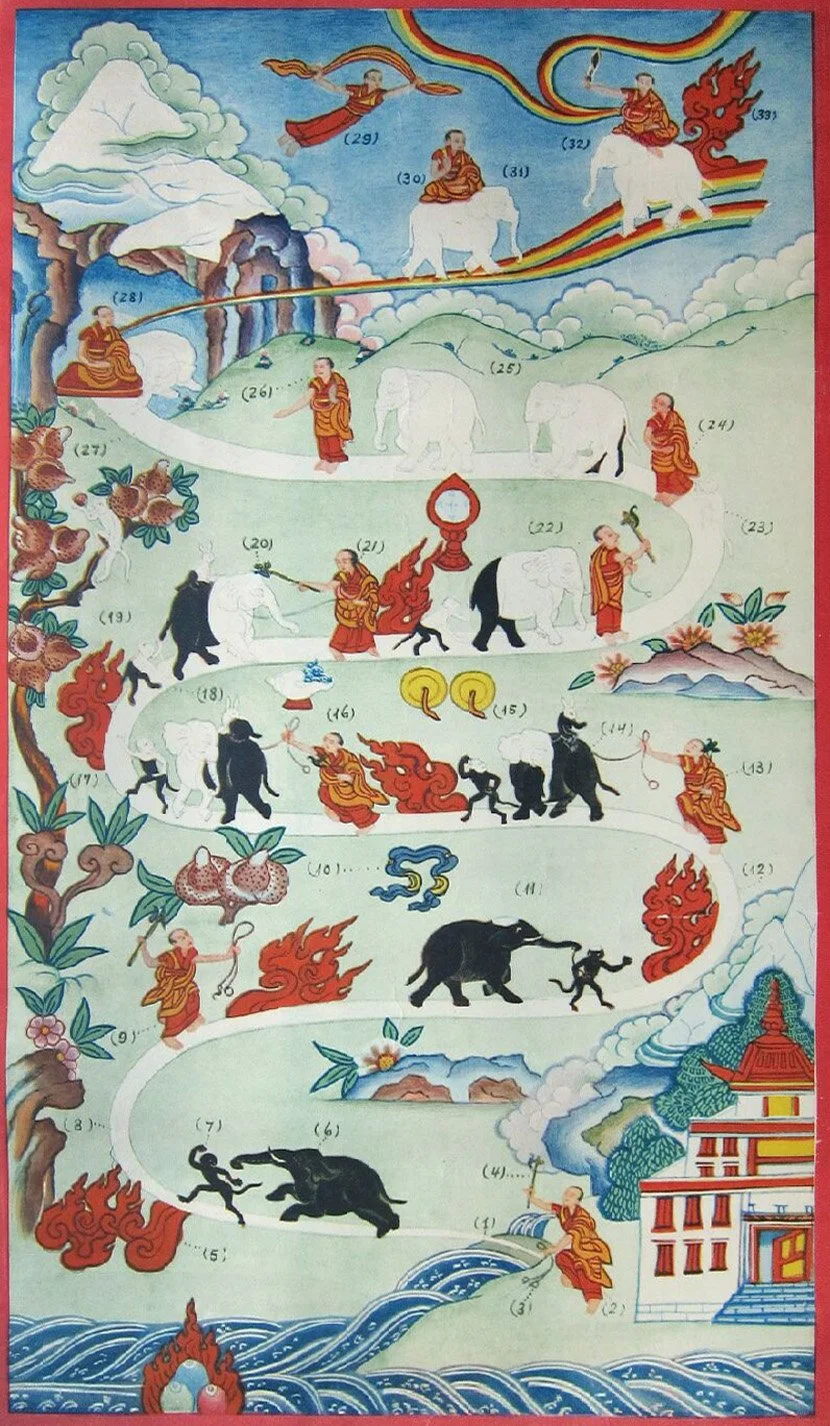
There is a traditional Buddhist analogy that relates the meditative process of calming the mind with the task of taming a wild elephant. As you would imagine, a wild elephant is a large and powerful animal. If left to run around a village untamed it could cause tremendous damage. Similarly, an untrained, untamed mind is equally willful, wild, and dangerous. Yet, just as a tamed and trained elephant obeys its master, so too does the trained mind obey its master. The result being a reduction in suffering, for the self and for the world.
The elephant analogy continues. To tame an elephant, it is tied to a tree with good strong rope. At first the elephant will struggle, but eventually it will settle down and you can start to feed it, first from afar, and then by hand. In time it will become easier to handle, eventually allowing itself to be safely used for village work without the need for the rope. In other words, the elephant is now tamed.
In this taming the wild elephant analogy, the elephant is your untamed wild mind, the rope is mindfulness, and the tree is the object of your meditative focus, traditionally the breath.
The elephant analogy concludes that just like a tamed elephant can be extremely useful in village life, so too can a tamed mind be extremely useful for your life. With the improved focus and clarity a tamed mind brings we can then get onto the real work of our mindfulness practice. We can start to expand our scope of focus beyond the breath, sound, or physical sensations and onto the more subtle aspects of the human condition. We can begin investigating the nature of our thoughts, emotions, or moods. We can turn attention upon itself or direct it to investigate consciousness as a whole; investigating what it is, what it contains, what it means to know, and how it is knowing it. We can use it to explore the fundamental nature of our existence, and attempt to answer one of the deepest philosophical and traditional questions; is the ego an illusion?
We use mindfulness to stable the mind, then we can use that stable mind to investigate the nature of consciousness and the self.