Mindfulness is often described as something we practise in everyday moments, but developing a consistent formal mindfulness practice can be a powerful way to strengthen self-awareness, emotional regulation, and overall wellbeing.
In this chapter from my book about mindfulness, I will explore the importance of creating a daily meditation routine and share guidance for those wanting to deepen their understanding of mindfulness. Drawing on my professional experience in mental health as a psychotherapist and meditation instructor, as well as my own journey of healing and personal growth, I will also share a list of how to meditate books that I have read and loved.
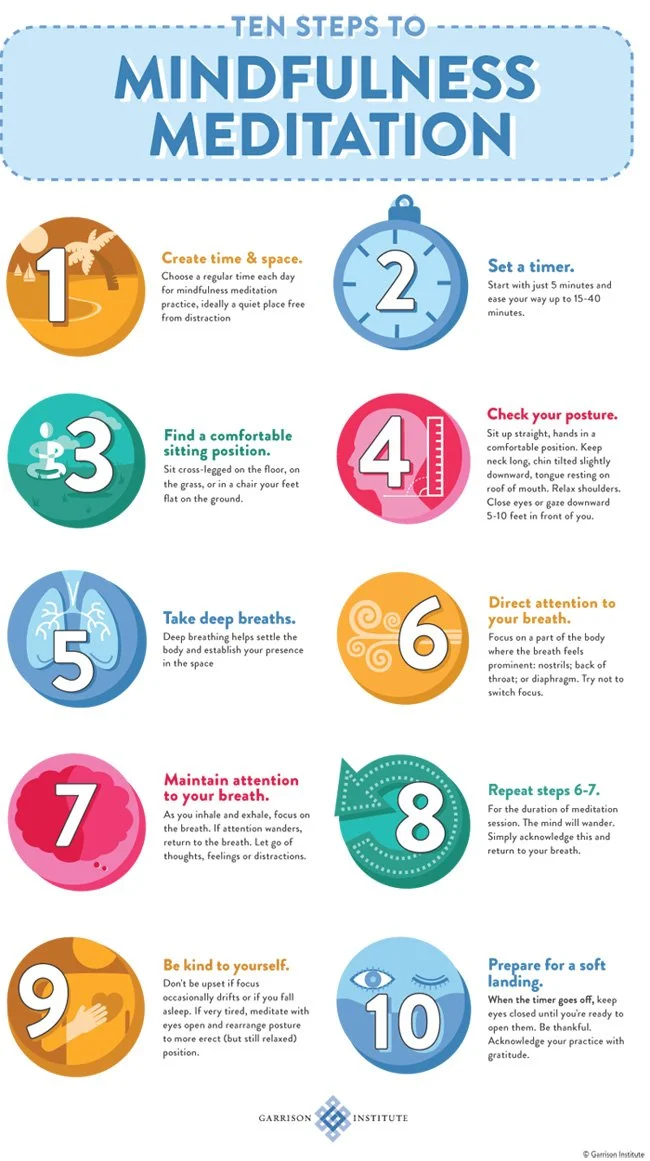
Amazing summary by the Garrison Institute
- A chapter from my book Mindfulness, A Guidebook to the Present Moment -
This section brings together all the practices, techniques, and concepts introduced in this book. It will serve as both a short summary and as an option to refer to for your daily mindfulness practice.
Firstly, please keep meditating! There is a lag between our formal mindfulness practice on the meditation mat and the benefits to our mental state. But just as we know that if we keep lifting in the gym we will get stronger, we need to keep in mind that if we continue to meditate we will eventually see positive changes. Reductions in anxiety and rumination, as well as an increase in clarity, calm and focus. Our relationships will improve, along with our decision-making abilities. We will begin to know ourselves on a deep level and therefore be in a better place to make decisions for our future.
I encourage you to continue your formal mindfulness practice daily, using any of the techniques shared in this book. Try them all and keep the tools that work for you; but do come back around every so often as your continued practice and knowledge may open new areas to consider and explore.
Remember, our goal is not to ‘meditate correctly’, but rather to attain mindfulness. This is an important distinction to keep in mind. Traditions, religions, and some gurus and instructors, tend to focus on the ‘correct way’ to act, think and practice. And while there certainly are benefits to such an approach, they quickly disappear if the focus moves away from mindfulness and towards rigidly doing things a certain way.
‘Accept my words only after you have examined them for yourselves; do not accept them simply because of the reverence you have for me.’ – Buddha
Put simply, you are meditating correctly if you are mindful, and it doesn’t have to always be formal either, although a consistent practice really helps increase the benefits. All instructions in this book, online, and from teachers, are mere fingers pointing to the moon. That is, they are guidelines, not prescriptions. With that said, let’s take a brief look over all of the content covered and put it into a workable daily routine for you.
Mindfulness is the awareness that arises from purposefully paying non-judgemental attention to the present moment. This state of awareness is the goal of our meditation practice. It comes from observing the contents of consciousness as they are, for what they are. In a sense, mindfulness meditation is the cessation of action, and the total acceptance of what arises.
The traditional way to practice mindfulness meditation begins with a focus on breath entering and leaving the nose. When our mind wanders, we simply and gently return our focus back to the breath. There are a few techniques we can employ to assist with this process, including ‘labelling’, ‘counting’ and the use of our ‘broad awareness’ to pick up on potential distractions as they arise. We added an induction to our daily formal mindfulness practice sessions, with the goal of setting the internal and external context in a way that best fosters mindfulness.
As with everything, practice makes perfect.
In addition to traditional breath focused mindfulness, we have also looked at the use of different items, actions, and sense data as potential meditation objects. These objects can literally be anything of course, but the traditional alternative to the breath includes mindful walking, with a focus on the sensations entering and leaving the feet. We considered using our daily activities as another avenue for increasing our mindfulness throughout the day, for example, when exercising, cleaning, waiting in line, before we touch our phones, when we touch a door handle, or when we see or hear nature.
Regardless of the object we choose, it is important to keep in mind that our goal is to be mindful, not to bliss out or fall asleep.
We can use our informal or formal mindfulness practice in response to extreme emotional states, conflict, and the feelings of addiction, by acknowledging the contents of our consciousness mindfully. This way we will be in a better position to act with an increasing level of detachment and thus ultimately take more long term beneficial and positive actions.
It is important to keep in mind the nature of our thoughts. We are not our thoughts, rather we are the thing having them, or more specifically from a mindful perspective, we simply witness them. If we can detach and observe our thoughts mindfully, we will feel less trapped by them, and will subsequently be less likely to fall into them or be pulled along by them.
I want to reiterate that regardless of how you practice mindfulness meditation, it is ideal that you do it daily as a formal mindfulness practice. The benefits of doing so are exponential, both in terms of habit building and cumulative impacts on your mind. You need not commit much time. I literally started with one minute per day. Just one. From there, I increased it slowly, minute by minute until I got up to 30 minutes of formal mindfulness practice every morning, with additional mindful breaths and moments taken whenever possible. Your meditation practice is like exercise: it is far better to do a little each day, then a lot one day, and nothing for a week. Mindfulness is like a muscle, and like all muscles if you overtrain it, it will be sore and you may not want to engage the next day. Pace yourself, build up your practice and do small amounts daily.
I have found it tremendously beneficial to share the benefits and the reasons why I am meditating with my family. Not only does this encourage them to all get involved, but they all know why I am meditating. They know that if I get my meditation time I am a better father, partner, and friend. So, carve out a small meditation time and space and inform everyone of your intentions for your formal mindfulness practice.
How To Start a Formal Mindfulness Practice
Any of the Meditations and Glimpses found in this book can be used as the basis of your formal mindfulness practice. I suggest you look back over them all and return to the one that clicked with you the most and use it to establish an ongoing daily meditation and formal mindfulness practice.
Doing some meditation each day, even a little bit, is the single most important thing for a beginning practitioner. So, start small with just one mindful breath each day. But if you have the time, space, motivation, and commitment necessary, start with five minutes of formal mindfulness practice every day, then slowly increase that time by one minute each week, until you find the amount that works for you. That is a time that both fits with your life and best benefits your ongoing metal state.
We will finish with a guided meditation that aims to bring together all the main practices contained within this book. It will be written assuming you have 20 minutes to meditate, but feel free to shorten or extend it if you like. You can use it as a prompt for your daily formal mindfulness practice if you like.
Your Daily Formal Mindfulness Practice
Set a timer for 20 minutes and take a seat in your meditation area. Close your eyes and take five slow and deep breaths, in through the nose and out through the mouth, then let your breath continue naturally. Gently draw your attention onto the sensations of the breath and begin the induction process.
Consider your motivation: Why have you chosen to meditate? What is the purpose of your ongoing practice.
Consider your purpose: What do you hope to accomplish in this session?
Consider your expectations: Make sure you do not get caught up in expectations of progress. Despite your goals and purpose, remind yourself that can only have the meditation that you are having.
Consider your diligence: Make a pledge to engage in the practice fully. Make a commitment to not engage in daydreaming, future planning, rumination, or other temptations.
Consider any possible distractions: Take a moment to think about your current mental state. What could be a potential distraction, both internal and external? Acknowledge and address them.
Consider your posture: Make sure you are in your ideal meditation posture prior to beginning. A comfortable position that will not make you drowsy or cause pain.
Now return your focus back to the sensations of the breath at the nose, and then slowly and deliberately begin to count them as they come. Label the the first breath as 1,1,1,1 and the second as 2,2,2,2 and so on, all the way up to 10. If, at any time, you find yourself lost in thought, simply acknowledge the distraction, and return your focus back to the sensation of the breath entering and leaving the nose.
Now we are going to engage our broad awareness. So, continue to pay focused attention to the sensations of the breath, but also note what your broad awareness is picking up. If you notice a memory, thought, feeling, mood or other mental phenomena, label them as such and then return your focused attention back to the sensations of the breath.
Continue to gently return your attention back to the sensations of the breath entering and leaving the nose for the rest of the session.
As you close off the session, end with the intention to bring the benefits of your formal mindfulness practice off into the rest of your day.
How To Meditate Books and Resources To Explore
This section provides you with recommendations on how to meditate books that I have read and loved (and I couple that I wrote) as well as some other resources to extend your formal mindfulness practice further. The first one we have already mentioned is Mindfulness: A Guidebook to the Present Moment.
Be Here Now – Ram Das
The book is more of a journey than an instructional. Written at the height of the spiritual awakening of the 60’s and 70’s this book will take you on a trip. It will show you the deepness of potential insights and awakenings that meditation can bring, while also highlighting the potential dangers of losing yourself to the pursuit.
Mindfulness in Plain English – Gunaratana
Using simple and concise language, this book provides a wonderful introduction to mindfulness approaching the topic through the clear use of concepts, backed up by analogies, anecdotes, and relatable stories. It teaches mindfulness as an artform, perfect for right-brain thinkers.
On Having No Head – Douglas Harding
This book is a pure invocation of natural awareness. It will convince you with both logic and practical experiments, that unlike everyone else, you have no head. Rather what you are is ‘space for the world’ and as such, you are free.
10% Happier – Dan Harris
A real world look at the impact that a meditation practice can have on a person, their relationships, and career. This book makes no grand promises or claims, merely the suggestion that daily practice will make you 10% happier.
The Waking Up App – Sam Harris
An incredible, well priced app for mindfulness and self-inquiry. Every day you are greeted with a new guided meditation that ranges the spectrum of awareness, mindfulness, Zen, Dzogchen and Metta based practices. It also contains a collection of interviews with world renowned meditators from multiple traditions and approaches.
Insight Timer App
Here you will find a collection of talks, guided meditations, interviews, podcasts and poetry from 1000’s of instructors from all over the world, including me! I host my mindfulness and creative writing courses there as well as an ever-growing collection of short talks and guided sessions.
Lucid Dreaming – Stephen LaBerge
There are many books on the topic of lucid dreaming, but LaBerge was the first to provide the world with a scientifically verifiable approach to the practice. If you want to complement your mindfulness with lucid dreaming, start here.
How To Get Your Sh!t Together – Zachary Phillips
The last self-help book you will ever need. In this book I share a collection of practice advice, tips and techniques that will take you from a place of barely surviving to passionately thriving. Things that helped me to overcome anxiety, defeat depression, move on from trauma, get organized, find meaning, and follow my dreams.
Meditation: The Art of Doing Nothing – Naval Ravikant
This is a collection of tweets, but do not let that discourage you. It is likely the single most concise meditation explanation and instruction you will ever read. His 60 day meditation challenge will change your life.
One Blade of Grass - Henry Shukman
This book masterfully shows the healing power that comes from simply sitting in silence every day, as well as the benefits of combining an internal practice with traditional western approaches to mental health.
Zen Mind Beginners Mind – Suzuki
A masterclass in attention to the present moment. This book provides an in depth look at Zen, but sheds insight into the nature of consciousness and mindfulness. It is both practical and beautifully esoteric at the same time.
Trauma Sensitive Mindfulness – David Treleaven
Modern neuroscience combines with traditional Buddhism to produce a book that aims to bring mindfulness to those who have suffered from trauma. It provides wonderful alternatives to the traditional practices that some can find triggering or wholly inappropriate given their past experiences and current medical conditions.
The Little Book of Being – Diana Winston
Most meditation instructionals cover the spectrum of awareness, yet this book places the practices into an easily understood and practicable hierarchy. It clarifies some of the more esoteric practices and puts them within reach of the lay practitioner.
The Mind Illuminated – John Yates
A scientific approach to mindfulness that breaks down the skills, knowledge, and milestones a meditator will need and acquire as they move from complete novice into an advanced practitioner. This book is well organized and referenced, perfect for ‘left-brain’ thinkers.