When “Not Perfect” Feels Like Failure

The Fear of Imperfection
Atelophobia
The fear of imperfection.
The fear of not being good enough.Crippling inaction.
Stuttered words.
No self-worth.The fear of failure causing failure.
Not inability, talent or a lack of opportunity.Just fear.
Just anxiety.
Just unattainable standards.Standards put upon by myself.
Standards forced upon me by the world.Others can fail.
Others can be imperfect.
Others can have fun.Just stop.
Please don’t placate me.
I know ‘no one cares about that stuff’.
I know ‘we all make mistakes’.
I know ‘I’m only human’.Reason doesn’t stop the thoughts.
By definition a phobia is illogical.My only solace comes from the diagnosis.
Knowing that I am not alone.
Perfectly imperfect, together.

“The fear of imperfection.
The fear of not being good enough.”
Perfection is unattainable. No matter how hard we try, we will always fall short. Initial progress comes quick and easy, but as we progress, the time and effort to make similar gains becomes exponentially harder. To get a task to 50% complete may take less effort than the final 10%.
Chasing perfection is like trying to find the end of a rainbow. As we approach it, it shifts just a little further. The problem is that perfection is subjective. My perfect will not be the same as your perfect, nor will my perfect stay the same over time. This is true for exercise, family, relationships, careers, financial, or attainments of any kind.
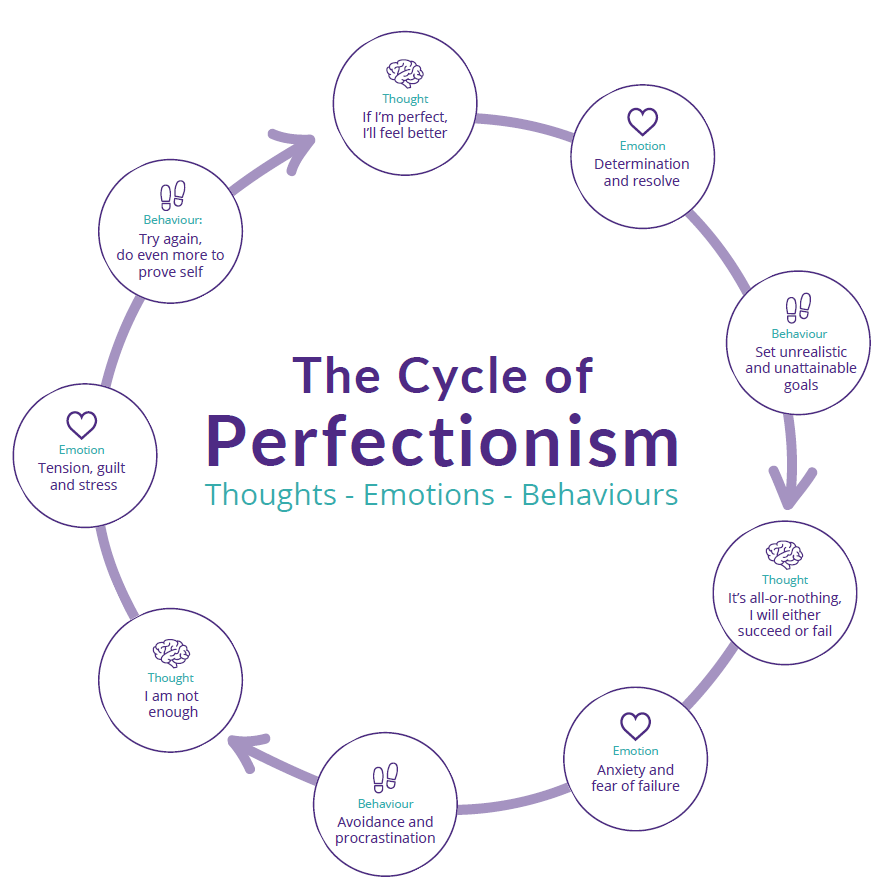
When we attempt to reach our goal, our efforts change us, thus what we now perceive as perfect has also changed. So, we set a new goal, one that is ‘truly’ perfect and then start the process over. We end up stuck in an endless loop of goal revision, one that can stifle all forward progress.
“The fear of failure causing failure.
Not inability, talent or a lack of opportunity.”
Take this book as an example. God knows it is not perfect, there are likely spelling, grammar and formatting issues that went unnoticed through the editing process. I could have made better word choices and eliminated superfluous paragraphs. Could I have spent more time and done a better job? Of course. I could have put this book through many more revision cycles, shown it to countless alpha and beta readers, and hired a second proof-reader. If I had done so, that book would certainly have been of better objective quality than this one.
So why didn’t I?
Simply put, this book is good enough. The words on the page do a good enough job conveying the meaning I hope for. The cost of the changes, in time, money and effort would have outweighed the benefits of further revisions. And importantly, I wouldn’t have had the space to work on my next project, or the next.
In fact, if I worked with the goal of perfection in mind, you would not be reading this book at all. I would still be revising my first book. Don’t get me wrong, its first chapter would be a killer, but it would go unread, having never passed the perfection test.
“Crippling inaction.
Stuttered words.
No self-worth.”
I prefer to live by the ‘done is better than perfect’ rule. I aim to get things to an 80% standard, then I move to the next project. This ensures that I am able to share my art and grow. I learnt many valuable lessons from finishing my first book. The act of writing, editing, publishing, and releasing it to the public taught me a lot, lessons I couldn’t get any other way.
I am now a better writer than I was prior.
Thus, were I to go back and revise my first book, I would be able to make significant improvements. My current abilities applied to revision, would result in a better book than had I have spent all this time exclusively working on it. It is not a stretch to know that future me will look back on this book in a similar light. Don’t get me wrong, I want to create the best quality books I can, and I hope that you are getting something meaningful from this one. But there is a need to balance the strive for perfection with the realistic constraints of time, money, passion, and focus.
Put simply, there comes a time when we need to say it is good enough, and then move on.
“Just fear.
Just anxiety.
Just unattainable standards.”
The truth is that no one is perfect. You are not perfect, I’m not perfect, and neither is the person you are crushing on. Your parents, boss and favourite actors all have flaws. Everyone can improve some aspect of their lives. Even world champions recognise the importance of practice and self-improvement.
Our idols only appear perfect because from our vantage point, they are far more skilled, successful, attractive, rich or competent than we are. But if they were to have an honest conversation, they would share aspects of themselves that they wish could be changed. They would highlight the blemishes, reveal the gaps, and show you the small tweaks that they desire. What’s more, if we were to work on the areas that they excel in, we would notice small areas where they are lacking. As our skills improve, we would get an eye for the game. We would be able to better see the landscape and thus judge them in a fairer light.
Besides, perfection is subjective.
Take looks for example. What you find attractive will differ from others. Thus, even if you were to obtain the impossibly ‘perfect’ standard of beauty, some people would not be that moved. They may recognise that you look good, but you would not be perfect for them.
It runs both ways. What you consider a defect, may be considered a plus for others. Too tall, large, or small? There are people into that. Wrong colour or style of hair? Skin not the right tone? Too many freckles? These are factors that attract some people, and to change them would be to diminish your beauty in their eyes. What’s more, your perception of perfection is constantly shifting and evolving. What you idealised as beauty as a pre-teen will be different from what you will consider beauty at 45.
This same subjectivity is true for morality, intelligence, business, and life success; some may consider your failures a success, or at least far closer to success than their current position.
Perfection is unattainable, and to strive for it leads to suffering.
The process of going bald felt catastrophic. Losing my hair signified the loss of youth, good looks, and confidence. It felt like the end of the world and I tried desperately to retain it. None of the treatments worked and I was left contemplating hair transplants, or even a scalp tattoo. It sounds ridiculous to consider now, but I had these thoughts on repeat in my mind. When I finally bit the bullet, accepted my fate, and shaved it all off, I realised that I was fine. For the most part, nobody cared. In fact, many people actually preferred my new look, and I discovered that there is a significant proportion of people who find bald men attractive.
Acceptance is the key.
I am not advocating passivity; the pursuit of perfection is a major motivating factor and quite useful, provided you do not let it get out of hand.
“Standards put upon by myself.
Standards forced upon me by the world.”
Our world is interconnected in unprecedented ways. Global transport and instant mass communication have given us access to information and support structures that our ancestors could only dream of. This is leading to a global awakening of sorts. The more we communicate and connect, the more we realise that we are one species, connected by the same hopes, dreams, fears, and expectations.
Yet this connectivity brings its own unique challenges. Social media grants us access to the people we would never otherwise meet. At a click we see pictures showing us their best times. The wins, the joy, the connections, the experiences, the holidays, the weddings, the food they are eating, and the people they are seeing. Their feeds show us a perfect life. And when the feed shows us ‘bad times’, it is sanitised, not a true representation of the event, rather only what the person chose to post about the event, complete with a well-polished caption.
What we are shown is a highlight reel; a filtered version of reality, full of amazingly attractive people always doing exciting things. We do not see everything that our friends post, rather our feed is curated by complex algorithms designed to keep us coming back to the platform. The problem comes when we fail to see that that is what we are observing.
We see just perfection.
Then we compare that perfection against our lives, and quickly realise just how mundane, boring, and flawed we are by comparison. We are privy to all our fears, doubts, issues, and emotions, and none of theirs. Then we make false assumptions, believing ourselves to be imperfect, because when compared to the feed, we are.
Real life cannot compete with curated fiction, yet this is what happens every time a casual scroll triggers jealousy, regret, or longing. In reality, the people posting the very same photos that are making us jealous, will themselves be scrolling their feeds feeling jealous by our posts. You don’t need to abandon social media, just rather to recognise it for the double-edged sword that it is. If we know the inherent dangers, we can better prepare ourselves to manage its impact. Use social media to get inspired, stay informed and to connect. But just take note of when you are using it and how often. Detach and observe the emotions it brings out in you. And if you do not like the result, make some changes.
“Others can fail.
Others can be imperfect.
Others can have fun.”
All fear is an adaptive response.
Operating correctly, fear is a tool that shows us where we are at risk. By heeding fear’s advice, we will have a better chance of survival and prosperity. The issue comes when our fears get too strong and overwhelm us. If we are so afraid that we can no longer act, our fear response is no longer adaptive. Ironically, when pushed to extreme levels, the fear of imperfection can cause us to freeze and stop acting, causing the very imperfection we hoped to avoid.
“Reason doesn’t stop the thoughts.
By definition a phobia is illogical.”
When our fears overwhelm us, we get bogged down inside our mind; trapped in the minutia, ruminating on all the things that we are doing wrong. All thought, no action. Mindfulness meditation offers a way out. It enables us to see fear for what it is, just a collection of biological and psychological responses. Mindfulness shows us that these changes are separate from what we are. We are the thing observing fear, not the fear itself.
Let’s approach this by way of analogy. Are you a big toe? Or are you the thing that has a big toe? Most respond to this question affirming the latter. Feeling that ‘they’ are located somewhere inside of their heads. They acknowledge that whilst they can move, use, and feel their big toe, they feel like it is more like a piece of connected hardware, as opposed to an operating system.
‘I am the thing with the big toe, not the big toe itself. Look at it, I am over here, and it is all the way down there.’
It is possible to observe our inner worlds with this same kind of detachment, ‘I am the thing having the thoughts, not the thoughts themselves. Look at them, I am over here, and they are over there.’*
This analogy has further weight when we stub our toe.
Most of the time we pay no notice to the workings of our toe. It is just there doing its thing, sending sensory data to the brain allowing us to walk. We are so detached from this process that it is practically unconscious. Yet when we stub our toe all our attention is instantly drawn towards it. For a few moments, ‘we are’ the toe. The sensations coming from it completely fill our consciousness. Yet, this is the same toe that moments prior was all but ignored. The more extreme the pain, the more completely we become lost inside of it.
Fear operates in the same fashion. When we are anxious, we can have other simultaneous thoughts, yet as anxiety grows into fear, and then to terror, we lose ourselves to the emotion. The strength of the emotionality erodes our detachment, and we lose ourselves in it. We become irrational, primal animals, desiring the safety of a cave to hide in.
Yet, even with extreme pain or emotionality, it is possible to detach. This is not an easy process, and the associated feelings won’t simply diminish. Rather our connection to them will change. By observing what we are feeling, whether it be pain from our toe, or fear in our minds, we start to see it for what it is. The more mindful we become, the easier it is to see the boundaries of the sensation. With practice we can detach enough to add some space between the sensations and ourselves, enabling us to make better choices.
“My only solace comes from the diagnosis.
Knowing that I am not alone.
Perfectly imperfect, together.”
Perfection is an ideal to strive towards, not a state that can be attained. Not by you, me, or anyone. Acceptance is the key to balancing the fear of imperfection as an ideal state against the realities imposed upon us by time constraints, and the limits on our energy, money, and other resources.
If we accept that nothing can be perfect, yet do our best to try, we will come as close as humanly possible. If you are constantly revising, rarely finishing projects, or perpetually working on incremental changes, then perhaps it is time to accept it and move on. The fear of imperfection can blind us to the big picture. It can make us work so hard on one aspect of our lives, that the rest is all but ignored. Leaving us ‘perfect’ in one area, and woefully inadequate in others. This is clearly not ideal for functionality or long-term success.
“Just stop.
Please don’t placate me.
I know ‘no one cares about that stuff’.
I know ‘we all make mistakes’.
I know ‘I’m only human’.”
Look at your inner voice, what kinds of things do you tell yourself? How would others respond if you were to speak to them the same way?
You speak to you more than anyone else.
You are constantly in your ear and you are always listening. Your inner voice matters. So, take some time to address it. Highlight your accomplishments and successes. Note the obstacles that you have overcome and the positive changes you have made. Forgive yourself for the transgressions and embarrassments of your past. You are no longer that person, you learnt from those actions. Commit to daily self-care and acknowledge the work that you are taking to grow. Take stock of all that you are grateful for in your life. Remember the moments of joy, love and happiness that you have experienced.
Recognise that you are taking action.
Regardless of how imperfect you ultimately are, you are moving forward. You are improving, so celebrate that fact. You will not stop, and will not fall back into old habits, because you know where that path leads. Appreciating yourself and your progress will not take you off that path, rather it will help you to stick to it. You will see just how far you have come, and how much you have grown, and you will be able to accept the rest of your journey with ease.
*There is a debate around our true nature, often presented by two distinct positions of thought. One holds that there is a distinct and unchanging self at the center of everything. The other holds that at center there is a void or emptiness. There are traditions, texts, philosophies, and experts (both spiritual and scientific) who believe in the validity of each claim. The good ones suggest that we meditate and contemplate to discover the truth for ourselves. I do not know the answer but agree with committing to the search.
This chapter is from the book Reflections Of The Self: The Poetry, Insights, and Wisdom of Silence