Doing Enough vs. Overdoing It
Are You Doing Enough?
- Ch: 6.10 of How To Get Your Sh!t Together -
“Remember how far you have come, not just how far you have to go. You are not where you want to be, but neither are you where you used to be.” – Rick Warren
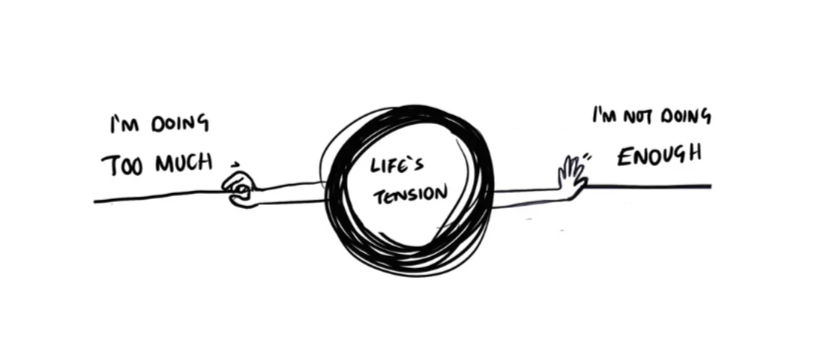
Have you ever had the experience of coming to the end of a long productive day, looking back over what you have done and feeling completely dissatisfied with what you managed to accomplish? You know you can do better, and you should do better. Friends and family tell you that they could never hope to do as much as you, but you feel like you could do more. In fact you know you can do more. But despite your results, you end the day berating yourself for not living up to your potential? If so, this chapter is for you.
I am always wanting to improve myself, to write more, exercise more, read more and do more. It feels like there is simply not enough time in the day to do all of the things that I want to do. Don’t get me wrong, this trait is great for getting things accomplished, but the problem is that it can feel like no matter how much I do each day, it is never enough.
These feelings are toxic for my mental state. Thoughts of ‘letting myself down’, ‘not reaching my full potential,’ and of worthlessness and inadequacy begin to circle in my mind. At times, they trigger bouts of mental affliction that can be so severe that I am taken out of action for days on end. This subsequent lack of action only adds to these feelings, it proves them right.
When I first realised this cycle, I decided that the best course of action was to simply do more. Initially this was quite motivating. I improved my diet and upped my exercise levels. I implemented a meditation regime and began writing daily. I read more and I studied harder. Unsurprisingly, my life began to significantly improve.
Despite initially subsiding, the feelings of having not done enough crept back into my mind with increasing frequency. In response I doubled down on my efforts. I began scheduling my days, taking out inefficiencies and removing activities that were not directly in line with my goals. I started waking up earlier and going to bed later to get more time out of the day. Once again there was a significant improvement in my performance and output.
Unfortunately, the feelings of worthlessness and inadequacy kept coming back. No matter what I did each day, chances are that I would still feel like I hadn’t accomplished enough. I could be twice as productive as the previous day and still feel the same lack of accomplishment. Something had to give. It was clear that a solution involving any variation of ‘doing more’ was not the answer. There is of course an upper limit to what can be done each day. Once I found that limit, pushing beyond it would only cause a breakdown of functioning as I inevitably became overworked.
The process of overcoming this issue has taken a very long time for me, and is always ongoing. It is a continuous battle because I always know that there are better ways to do things, and there is always more to do, experience and learn. There really is no upper limit to fitness, intelligence, or meditative practice, other than the limits that life imposes upon me. Yet, those limits are real. I really do have limited energy levels, focus and time.
How Do You Know If You ‘Have Done Enough’?
Providing yourself with an honest answer to this question requires applying the skills of detachment, acceptance and self-awareness to the situation. A lot of chapters in this book will have helped you to hone these skills, so I won’t dwell on the how to of developing those skills again here, other than to point you towards relooking at chapter 1.9 ‘Meditate’, chapter 2.3 ‘Status Check’, and chapter 3.2 ‘Accept Reality’ if you need a refresher.
Whenever feelings of ‘Not Having Done Enough’ arise, the first thing that I try to do is to calm myself down. I find that the calmer my mind and my body is, the easier it is to think clearly and look at the problem objectively.
From there, I ask myself the following four questions.
1) What was my mental state at the start of the day?
2) What have I actually done today?
3) What are the real results of my actions?
4) What unforeseen or unplanned events have occurred today?
The answers to these questions show me the truth of my day’s performance. They take me out of my head and into the reality of what I actually accomplished, given my unique circumstances.
—
TAKE ACTION
For the next month, write down everything that you have accomplished each day. Include work, exercise, reading, cooking, cleaning, organising, practicing or any other ‘self-help’ activity.
Review this list at the end of each day, week and month.
The act of tracking performance will give you a clear look at what you have accomplished over a particular period of time.
You can add to this exercise by also noting down your mental state going into the day (see chapter 2.3 ‘Status Check’) as well as any unforeseen complications that you needed to address. These additions will paint a clear picture of not only what you accomplished, but also what you had to deal with each day.
—
Looking at the results of your actions is vital. You may not be where you want to be, but you have certainly come a long way. It is so easy to get caught up in goal attainment that you forget or discount just how far you have come, and the results that you are currently obtaining.
You may not be ‘there’ yet, but you are getting closer each day.
Although your ultimate goal may be years down the line, it is vital that you acknowledge the small wins. The little landmarks along the way that show you that you are making some improvement towards your goal. This could be body changes from diet and exercise, it could be improvements in productivity, it could be a cleaner house or a better behaved dog, it could be the completion of a part of a project, or some new competency at a desired skill.
The problem of course is that this kind of progress is often incremental and the change is typically unnoticeable on a day to day level. It is easy to fall into the trap of feeling like you haven’t done enough because it feels like you haven’t made any actual change. It is quite un-motivating to feel like you are putting in so much hard work and not seeing any actual results.
Balancing Mental Health With Ambition
This is the kicker. How can you ensure that you are working to your maximum potential while simultaneously ensuring that your mental health is maintained?
In chapter 2.1 ‘Guard Your Mental State At All Costs’, I discussed the importance of placing your mental state above all other things, primarily because a good mental state is a prerequisite to living a ‘successful’ life. Unfortunately, guarding your mental state is not as easy as ‘just relaxing’ all the time, or ‘playing and not working’. For a lot of people (myself included), their mental state is tied to their performance and work output. Accomplishing goals and completing tasks are vital components of a good mental state.
Therefore you need to be self-aware enough to correctly answer the following questions about yourself:
1) Was I ‘being lazy’ or was I ‘recovering from a mental affliction’?
As I have mentioned in previous chapters, the symptoms of a mental affliction can hit hard and can require me to undertake a recovery process, that from an external perspective may seem like ‘laziness’. I may watch a movie, read a book, have a bath, play a video game, or simply sleep.
So at the end of the day I need to consider my mental state. Why did I laze about for so long today? If I review myself and find that I was suffering from a mental affliction, then those behaviors can be classified as ‘recovery’ and are therefore acceptable to me. If however I was simply being ‘lazy’, then I may need to take action to cut some of that laziness tomorrow.
Note that I am not chastising myself here for being ‘lazy’. I am simply acknowledging that, on this day, I didn’t act in a way that I would like in the future. I have learnt how to be less ‘lazy’.
2) Was I ‘preparing’ or ‘procrastinating’?
Getting into the correct mind frame to undertake a particular activity can take time.
When I write, I need to ensure that my mind is clear, that I have no other obligations and that my workspace is set up and ready for me to perform. Exercise requires a similar kind of set up process. I need to ensure that I have all of my equipment with me, that I am fed and hydrated and that my mind is in a place to perform hard physical motions.
Unfortunately, there is an inherent risk of simply prolonging this preparation process indefinitely, which tips the scale into the realm of procrastination. It is important to realise that realistically, there is an infinite amount of possible preparation that you could undertake prior to taking action.
Sometimes you just need to start.
I have learnt to recognise how much preparation I actually need prior to starting an event. If I go too far over that preparation time, I know that I have been procrastinating. Similar to above, I am not chastising myself. It is easy to fall into the trap of procrastination, so I simply acknowledge that on this day, I didn’t act in a way that I would like to act in the future. I have learnt how to ‘procrastinate’ less.
3) Are my expectations ‘realistic’?
We often set ourselves daily goals that are far more challenging than they initially seem. We focus on what we want to accomplish, paying little attention to the inevitable limitations and challenges that will arise. When the day ends, we look at our actual performance and compare it to our goal and we are disappointed, we ‘Didn’t Do Enough’!
Only through countless repetitions of daily goal setting, and contemplation of my performance have I been able to get a good read on what I can realistically accomplish in one day. I have learnt that every task takes a lot longer than I think it will. There will always be unforeseen challenges, technical difficulties and timing difficulties. I need to eat, think and recover. Meetings will run late and some people will need more time to grasp what is required of them.
If I realise that I have set too high an expectation for myself, I make sure to readjust these expectations the next day to be more realistic to what is actually happening on the ground.
—
TAKE ACTION
Think back to your performance yesterday and ask yourself the following three questions.
1) Was I ‘being lazy’ or was I ‘recovering from a mental affliction’?
2) Was I ‘preparing’ or ‘procrastinating’?
3) Are my expectations ‘realistic’?
Calm and detached contemplation of these questions will help you to determine if you have really done enough!
—
If you determine that you haven’t done enough, please don’t berate yourself. Remember that you are human, it is okay and natural to have off days. Know that in time you will take action to address shortfalls in your performance and over the long term you will see improvement.
Your mind may naturally tell you that you have failed, that you could have done better or present you with thoughts and even evidence of your inadequacy. Don’t add to that fire. Instead, acknowledge those thoughts and make a commitment to making a change wherever necessary.
If on the other hand you determine that you have done enough, accept that while you may not have accomplished everything you initially set out to, you are well on the way. That given your unique mental state, life circumstance and attributes you have done the best you can that day. Congratulations, you really are following your dreams. This should be celebrated!
“Every success story is a tale of constant adaptation, revision and change.” – Richard Branson
Acknowledge Past Success
When we first learn a new skill or attempt a goal, the process to mastery is daunting. However the more we practice, the easier it gets. What once seemed impossible, becomes a run of the mill, mundane activity.
Watch a toddler who is learning to walk. It is a significantly challenging task that requires all of their effort and focus. They fail 100 times before they even take one step. When they start to walk they are bowlegged and unsure of themselves. They are slow, clunky and ineffective. Yet they persist. The smiles of joy when they start moving around the house fills the room. Fast forward a year, and they are no longer ‘happy’ at their ability to walk, it is no longer a challenge, no longer a massive accomplishment. They just walk. This process repeated time and time again throughout life.
What was once impossible becomes mundane.
Every aspect of life will have this same learning process inherent to it. Beyond the ‘developmental’ milestones of crawling, walking and talking, we also learn to read, write, complete arithmetic, operate technology, drive, and complete our work.
Taking this further, when you start ‘Following Your Dreams’ you will be forced to overcome many seemingly impossible tasks. Things that right now you feel you will never be able to accomplish, but you will. You may have to repeat these same activities time and time again. Eventually you will inevitably forget that at one stage those tasks were ‘impossible’. You will forget the tremendous effort that you needed to undertake to accomplish them or the changes that you made to become the person that can complete those tasks.

Try to hold onto some of the memory of the struggle. It will show you that although you are facing significant challenges now, you will get through them, just like you have previously done.
You will grow, and in time the impossible will once again become possible.
Over time, the ‘difficulty’ of initially completing such activities will eventually fade from memory. As you continue to improve, these ‘impossible’ tasks will be repeated with increasing ease. Make sure to keep reminding yourself that at one stage, they were ‘impossible’, yet you did them anyway. With slow, persistent effort, you can achieve greatness. Just don’t be too hard on yourself for not doing it all in one day!
TAKE ACTION
Take a moment to acknowledge the things that you have learnt to do now that you didn’t know prior to beginning your journey.
Note down the skills, accomplishments and abilities that you now take for granted that you previously had no idea about or considered ‘impossible’.
The next time you are facing an ‘impossible’ challenge, recall your prior accomplishments and take action.
—
Frequently Asked Questions
Q) I don’t feel like I have ever succeeded in anything.
A) When I am in a bad mental state, it is significantly harder for me to see my successes. So the first step that I would consider undertaking would be to work on that. If you have read this far, you now have access to many exercises that will have a positive impact on your mental state – provided you actually TAKE ACTION that is! If you have done so and are still struggling, I highly recommend hiring the services of a psychologist or counsellor to talk through your specific concerns.
However I will further add something that you may not have yet considered. The fact that you are reading this book suggests a desire to improve your life. Having that desire and acting upon it, is a success in itself.
You have made a choice to overcome mental affliction, get your life in order and to pursue your dreams.
This involves many ‘successes’ that are small and are often not directly noticeable. For me, a major ‘success’ was stopping my self-harming behaviors. It is not something that other people could really notice, or even understand, but for me it was significant.
Another one of these successes was making the choice to believe that I could be successful at something. Coming from a place of little self-esteem, it was hard to even consider that I could make myself into anything of worth, let alone get as far as I have come now. Beginning to believe in myself was the first step. One that you are already taking!
Resources
The War Of Art, Steven Pressfield
Mindfulness In Plain English, Bhante Gunaratana
The Mind Illuminated, John Yates
Summary
Compare your actual performance to your expectations, taking into account your mental state as well as the unexpected challenges that inevitably arise. If you fall short, don’t berate yourself over it. Accept that you are human and pledge to change your behaviour accordingly.
This chapter is from the book How To Get Your Sh!t Together